
General News
Monthly Market Commentary – September 2026
The Monthly Market Commentary (MMC) is an update on the world in which we invest.

Global markets summary
August served up one of those months that reminds investors why following every headline is an exhausting way to manage money.
There was plenty to worry about. Oil markets spent August lurching between relief and anxiety as tensions in the Middle East ebbed and flowed. Central bankers continued their favourite hobby of disappointing investors who were hoping for lower interest rates. And the market’s long-running love affair with artificial intelligence entered a slightly more mature phase, with investors becoming far choosier about who might ultimately profit from it.
Judging by the headlines alone, it should have been a difficult month for markets.
Instead, the opposite happened.
Company earnings continued to beat expectations, economic growth proved resilient and equities generally moved higher. The MSCI World Index returned 1.8% in sterling terms, while the S&P 500 gained 1.9%. Emerging markets and Japan were strong, both returning around 2.6%. It was another useful reminder that markets spend much of their time dealing with tomorrow’s problems rather than today’s news.
The more interesting story, however, was happening beneath the surface. For much of the last couple of years, it felt as though a small handful of technology companies were carrying the entire market on their shoulders. August suggested that investors are becoming less convinced that all the rewards from artificial intelligence will end up in the same places.
That isn’t bad news.
Markets are usually healthier when more companies are contributing to returns. Banks, industrial businesses, healthcare firms and energy producers increasingly joined the party. Bull markets supported by a broad cast tend to last longer than those relying on a couple of superstar performers.
Bond markets told a slightly different story. Higher energy prices complicated the inflation outlook and prompted investors to question how quickly central banks might cut rates. Returns were positive but subdued, with UK gilts gaining 0.2% and global high yield bonds returning 0.3%, while global corporate bonds slipped 0.2%. Gold, meanwhile, rose more than 12%, suggesting that while investors were willing to embrace risk, they were not abandoning caution altogether.
If that sounds contradictory, welcome to investing.
The mood music in 2026 has often felt gloomy, yet markets have been quietly getting on with the job. It’s another reminder that headlines are designed to capture attention, not predict returns. Investors who spend their time reacting to every twist and turn rarely prosper. Those who focus on owning good assets and keeping a long-term perspective usually fare better.
United Kingdom
UK equity markets underperformed global peers over August, though this fails to tell the whole story. Having underperformed for some time, mid- and small-cap shares outperformed for a second consecutive month and by some margin, outpacing the broader global equity index. The strength of small- and mid-cap shares is likely due to a combination of a significant valuation discount relative and a domestic economic picture that has proved better than feared.
The main concern for markets continues to be the risk of interest rate hikes, with the Bank of England particularly concerned by both the direct and indirect impact of higher oil prices on inflation. UK CPI rose to 2.9% in July, up from 2.6% in June, broadly in line with expectations. Core inflation (i.e. excluding food and energy costs) held steady at 2.6%, while services inflation edged down from 3.6% to 3.4%, a welcome sign that the energy shock has not yet fed through into wages and services prices. Wage growth also remained contained, with private sector pay ticking down slightly to 2.8%.
Reports from Bloomberg and others have suggested the Bank of England may be overstating second-round inflationary effects, though with inflation still above target, a sustained fall in the oil price will likely be needed before rate cuts are back on the agenda.
Despite these headwinds, the UK economic backdrop was encouraging. The UK was the fastest-growing economy in the G7 in the first half of 2026, with Q2 GDP growing 0.4%, in line with forecasts and supported by a strong services sector. Consumer confidence unexpectedly rose to a two-year high in August, and while the ONS reported a larger-than-expected budget deficit in July, the broader economic picture compares favourably with the Eurozone.
We believe that the combination of attractive valuation and a better-than-expected outcome from an economic perspective presents an attractive long-term opportunity in UK small- and mid-cap equities – having significantly underperformed European peers since Brexit and suffered sustained fund outflows. With UK growth forecasts better than expected and Bank of England forecasts around inflation proving too hawkish, we believe the case for this overlooked part of the market is strengthening and have positioned our UK Dynamic Fund accordingly.
North America
The death of cultural icon Dolly Parton in August prompted an outpouring of tributes from across America’s political and social divides. In a country where consensus has become increasingly scarce, she remained one of the few figures almost everyone could agree on.
The stock market, meanwhile, spent much of the month moving in the opposite direction. For the best part of two years, investors have shown remarkable unity of purpose. Buy the biggest technology companies, buy anything connected to artificial intelligence and don’t ask too many questions. It has been one of the strongest market consensuses in recent memory.
August offered further signs that this consensus is beginning to fray. Not because investors have fallen out of love with AI. The largest technology firms continue to produce exceptional profits and invest extraordinary sums in the infrastructure required to support the next wave of innovation. Rather, investors are becoming more curious about where the eventual rewards will accrue. As is often the case in markets, agreeing on the future turns out to be easier than agreeing on who gets rich from it.
The headline numbers remained reassuring. The S&P 500 rose around 2.69% in local currency terms during August (1.93% in £ terms), supported by another strong earnings season and an economy that continues to defy repeated predictions of an imminent slowdown.
More important than the index itself was what sat beneath it. Financials, industrials, energy and healthcare businesses continued to attract fresh interest, while investors became more selective within technology. This broadening of market leadership is often overlooked, but it is generally a sign of a healthier market. Bull markets tend to be more durable when more companies are pulling their weight, rather than relying on a handful of superstar performers.
There were reminders, too, that economics still matters. Higher oil prices, driven by renewed tensions in the Middle East, pushed investors to reconsider how quickly interest rates might fall. Recently appointed Federal Reserve Chair Kevin Warsh has shown little enthusiasm for offering markets the reassurance they crave, leaving investors to adjust to a world where interest rates may remain higher for longer.
For all the attention given to America’s divisions, the country’s greatest companies retain an extraordinary ability to adapt, innovate and generate profits. That remains the real investment case. We continue to hold substantial US exposure across our portfolios, not because America is free from problems, but because time and again its businesses prove better at solving them than investors expect. The market may be looking for its next chart-topper. We’re still happy owning the back catalogue.
Europe
Europe’s relationship with energy has always resembled a British summer holiday. Just when you convince yourself the weather has finally turned, it’s worth keeping a jacket within reach.
August offered another reminder why. On the face of it, the news was reasonably encouraging. Economic activity has proved more resilient than many expected, company earnings broadly held up, and sectors such as banks, industrials and defence continued to find favour with investors. After years of being cast as the slow-growth corner of global markets, Europe has quietly put together a respectable year.
The problem is that Europe’s fortunes remain unusually tied to events occurring well beyond its borders. Renewed tensions involving Iran pushed energy markets back into focus during August and reminded investors of a reality that has never fully disappeared: Europe remains a significant importer of energy. While businesses and governments have spent the last few years reducing some of the vulnerabilities exposed by the Ukraine conflict, higher oil and gas prices still have a habit of finding their way into European inflation, consumer confidence and corporate profitability more quickly than they do elsewhere.
That leaves the region walking a narrower path than the United States. American investors spent much of the month debating who might win from artificial intelligence. Europe found itself worrying about something rather more familiar: the price of energy and the impact it might have on growth.
To be clear, this is not a prediction of impending trouble. European companies have become more resilient, and many of the continent’s strongest businesses operate globally rather than relying solely on domestic demand. Defence spending continues to provide a meaningful tailwind, while banks are still benefiting from a higher interest-rate environment than they have enjoyed for much of the last decade. Yet we remain somewhat cautious.
One of the lessons investors have learned repeatedly over the last decade is that Europe’s challenges rarely arrive because investors can see them clearly. They arrive because something unexpected causes energy costs to rise, growth expectations to fall, or political unity to fray. August did not deliver that outcome, but it did remind markets that the risks remain.
From a portfolio perspective, Europe continues to provide useful diversification and exposure to areas that are less dominant in US markets. However, with geopolitical tensions once again putting energy security under the spotlight, we remain more attracted to the UK, where valuations remain compelling and the market’s significant exposure to energy producers can help offset some of the pressures that higher commodity prices create elsewhere.
Rest of the world
Investing in Asia can sometimes feel a little like following Test cricket.
The rules are perfectly understandable, the participants clearly know what they’re doing, and yet there are long periods where those watching from afar are not entirely sure why events are unfolding as they are.
August provided plenty of examples.
Japan continued to benefit from a story that has been building for several years rather than several months. Corporate governance reforms, higher dividends and a growing focus on shareholder returns are slowly reshaping a market that spent decades frustrating investors. There is nothing particularly fashionable about these developments, which is perhaps why they are so interesting. While much of the world remains fixated on the next technological breakthrough, Japanese companies are quietly doing something rather old-fashioned: becoming better-run businesses.
Elsewhere in Asia, the mood was rather more mixed. Many of the region’s largest markets remain closely tied to the global technology supply chain, meaning investors continue to wrestle with the same question confronting their counterparts in the United States: who ultimately wins from the extraordinary sums being invested in artificial intelligence? The answer appears less straightforward than it did at the start of the year.
China remains a market that can alternate between optimism and pessimism with remarkable efficiency. Encouraging economic signals continue to emerge, yet investors remain wary of weaker domestic demand and a property sector that refuses to disappear from the list of concerns. Every few months, the market appears convinced either that China is on the verge of a powerful recovery or a prolonged slowdown. The truth, as is often the case, probably sits somewhere in the middle.
Perhaps that’s the broader lesson from the region. The investment case for Japan, Asia and emerging markets has never been about predicting the next quarter’s headlines. It’s about recognising that an increasing share of global growth, innovation and consumer spending sits outside the developed Western economies. Sometimes, that delivers periods of impressive outperformance. At other times, as we’ve seen this year, it requires patience.
For now, we remain neutral across these areas. Japan’s corporate reforms continue to make a compelling long-term case, while Asia and emerging markets offer exposure to some of the most dynamic economies in the world. Equally, investors must contend with geopolitical tensions, uncertainty surrounding China and the ebb and flow of the technology cycle. The combination creates opportunity, but also enough uncertainty to justify a balanced approach.
Fixed income
If equity investors spent August debating the future of artificial intelligence, bond investors were having a much older argument: who is actually in charge here?
For most of this year, markets have behaved like a child repeatedly asking, “Are we there yet?” The destination is lower interest rates. The problem is that central banks keep replying, “Not quite”.
In this respect, August was another month of disappointment. Higher oil prices and renewed tensions in the Middle East reminded investors that inflation has a habit of returning just when everyone thinks it has been dealt with. For UK investors, it is a familiar feeling. Anyone who has watched petrol prices creep upwards or wondered whether household bills will ever stop finding creative ways to increase will understand why central bankers remain cautious.
Government bond markets reflected that reality. Both US Treasury yields and gilt yields remained elevated as investors pushed back expectations for future interest-rate cuts. Markets increasingly accept that central banks may be closer to the end of the inflation battle than they were a year ago, but they are also recognising that victory is unlikely to be declared any time soon.
For UK investors, gilts continue to occupy an awkward middle ground. Yields are unquestionably more attractive than they were for much of the last decade, providing a meaningful source of income once again. At the same time, longer-dated bonds remain vulnerable if inflation proves stickier than hoped or if rates stay higher for longer. We therefore continue to favour keeping duration relatively short rather than making large bets on a rapid decline in yields.
Our caution is even more pronounced in US Treasuries. For years, American government bonds were the unquestioned safe haven of global markets. Today, investors face a different backdrop: persistent fiscal deficits, elevated government borrowing and a Federal Reserve that appears in no rush to ride to the rescue. The income on offer is attractive, but we see better opportunities elsewhere.
Investment grade corporate bonds face a similar challenge. Company balance sheets remain broadly healthy, but the additional yield available over government bonds looks relatively modest given the risks involved. Put simply, investors are not being paid particularly generously for taking on extra credit exposure. That leaves us less enthusiastic than the market consensus.
High yield bonds present a more balanced picture. Ordinarily, the phrase ‘high yield’ sounds as though it belongs on the financial equivalent of a late-night infomercial, but today’s market is rather different. Many issuers entered this period with stronger balance sheets than in previous cycles and higher starting yields provide a useful cushion against market volatility. While we remain selective, we believe investors are being reasonably compensated for the risks involved.
One of the more interesting opportunities remains emerging market debt. It is the part of fixed income most investors tend to overlook, perhaps because it sounds more exotic than a ten-year gilt. Yet many emerging market economies entered the inflation cycle earlier than developed markets, raised rates sooner and in several cases now offer significantly higher real yields than their Western counterparts. Combined with improving fundamentals across parts of the asset class, that continues to make the opportunity set attractive in our view.
The broader message from bond markets is straightforward. Investors have spent much of 2026 hoping for rescue in the form of lower interest rates. August was a reminder that income itself remains the main attraction. In an environment where inflation risks have not entirely disappeared and central bankers remain cautious, we believe being paid today matters rather more than hoping for capital gains tomorrow.
Ask us anything
Q: The US owes more than $40 trillion. Should investors be worried?
A: Some numbers are so large they’re difficult to picture. The US government’s debt, now north of $40 trillion, is one of them. Unsurprisingly, it has become a favourite topic for commentators predicting trouble ahead.
The important thing to remember is that countries do not repay debt like households do. The US doesn’t need to clear the balance. It simply needs investors to keep lending to it and, so far, they have shown little hesitation in doing so.
Why? Because despite all the headlines, US government bonds remain one of the largest and most important markets in the world. The dollar is still the global reserve currency and, in times of uncertainty, investors often buy more Treasuries, not fewer.
That doesn’t mean debt is irrelevant. As borrowing rises, so does the interest bill. More government money goes towards servicing existing debt and less towards everything else. That’s one reason bond investors have become increasingly sensitive to US deficits and spending plans.
So, what does this mean for you? Not that we’re expecting a US debt crisis tomorrow morning. But it is one reason we’re cautious on longer-dated US government bonds. We think investors need to be paid properly for lending money for ten, twenty or thirty years when borrowing levels are this high.
For portfolios, the takeaway is straightforward: don’t confuse a long-term challenge with an immediate emergency. America’s debt burden is a genuine issue, but the world’s largest economy and deepest capital markets are unlikely to stop functioning anytime soon. The more relevant question is whether you’re being rewarded for the risks you’re taking.
At the moment, we see better opportunities elsewhere. That’s why we’re happier collecting income from a diversified mix of assets than placing a large bet on long-dated US government debt.
If there’s a question you would like to pose to our team, please reply to this email or write to investments@mattioliwoods.com.
Four key takeaways from August 2026:
- Markets ignored the noise. Global equities rose despite geopolitical tensions and rate uncertainty.
- The rally broadened. Returns came from more than just the AI winners.
- Rates stayed higher for longer. Investors scaled back expectations for imminent rate cuts.
- Diversification paid off. Strong returns came from the US, Japan, emerging markets and gold.
MARKET DATA
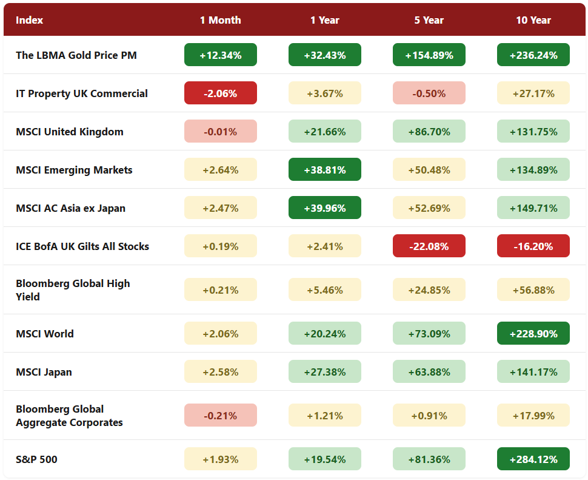
All performance figures are from FE analytics (as at 31/08/2026) and quoted on a total return basis in pounds sterling.
The Monthly Market Commentary (MMC) is written and researched by Scott Bradshaw, Lauren Hyslop and Jonathon Marchant for clients and professional connections of Mattioli Woods and is for information purposes only. It is not intended to be an invitation to buy, or to act upon the comments made, and all investment decisions should be taken with advice, given appropriate knowledge of the investor’s circumstances. The value of investments and the income from them can fall as well as rise and investors may not get back the full amount invested. Past performance is not a guide to the future.
Mattioli Woods Limited is authorised and regulated by the Financial Conduct Authority.
Sources: All other sources quoted if used directly, except fund managers who will be left anonymous; otherwise, this is the work of Mattioli Woods.
You may also like

Mattioli Woods renews Leicester Tigers partnership

Monthly Market Commentary – August 2026

Care costs dominate retirement concerns with most over-55s unprepared for Inheritance Tax hit
No results match your filters. Try a different tab or category.