
Employee Benefits
Support before crisis: what mental health provision should look like
Unfortunately, many workplace mental health conversations start too late.


By the time support is offered, an employee may already be, struggling in silence overwhelmed, or signed off sick.
The real question for employers is: what happened before the crisis?
Effective provision is not only about responding when things go wrong. It creates an environment where people can access help earlier, before pressure affects wellbeing, performance, or absence. That requires a shift from intervention to prevention.
World Mental Health Day offers a timely opportunity to ask an important question: “are our mental health strategies focused on helping people before they reach crisis, or only after?”
The challenge of early support
Mental health challenges often develop gradually. Workload, caring responsibilities, financial pressure, family concerns and personal circumstances can build over time, while employees continue to perform well and appear outwardly fine.
The scale of the challenge is significant. According to the Health and Safety Executive (HSE), an estimated 964,000 workers in Great Britain experienced work-related stress, depression or anxiety in 2024/25, making it the most commonly reported form of work-related ill health.1
People may not recognise that they would benefit from support, or they may feel uncomfortable speaking up. Some will fear judgement; others think their concerns are not serious enough. If support is seen as something reserved for crisis, employees are far less likely to use it early.
Making support easier to access
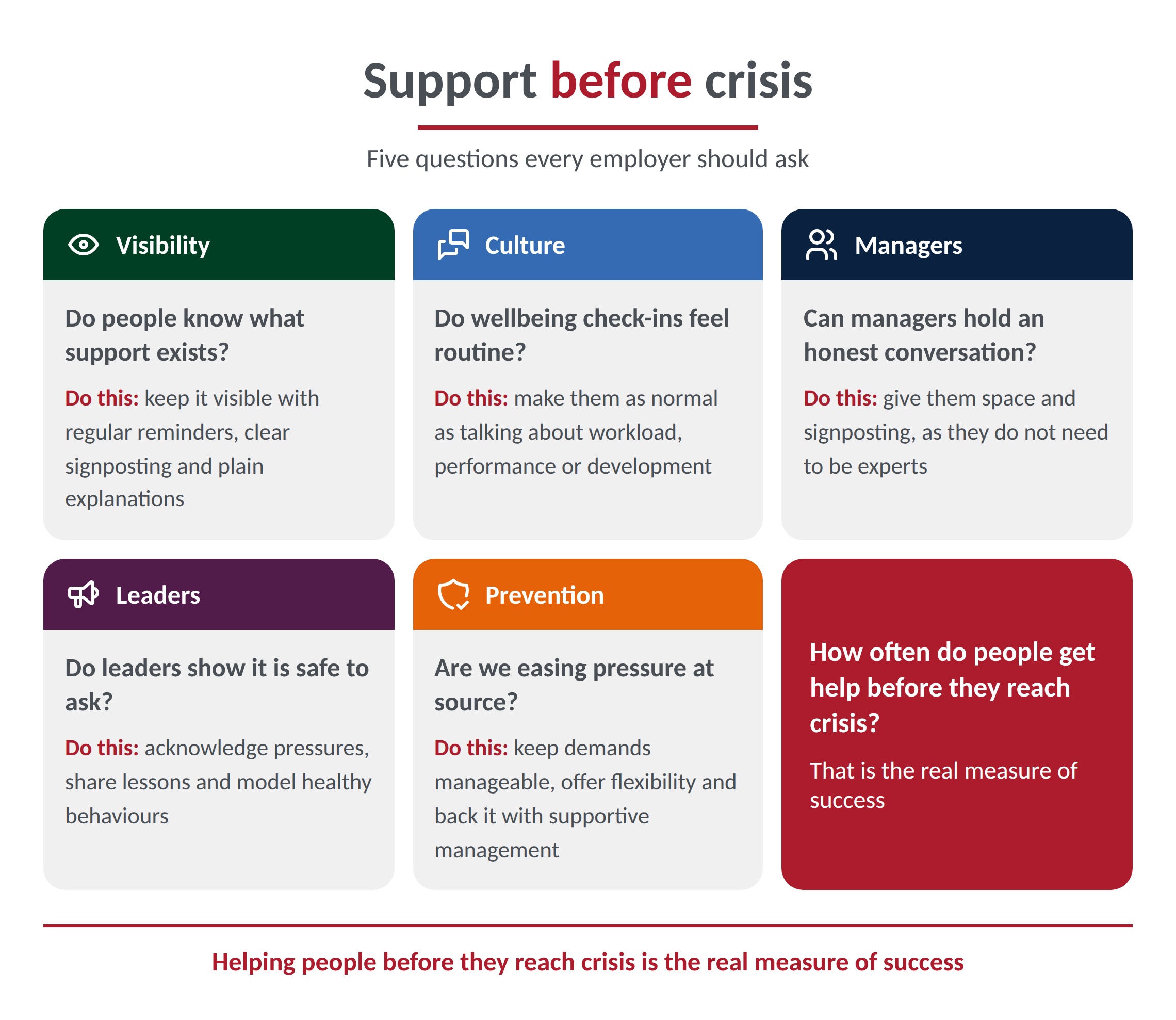
Employers should first ask whether employees know what support exists.
Organisations may invest significantly in wellbeing services, yet awareness remains low, especially when benefits are buried on intranet pages or mentioned only in annual communications.
This appears to be a common issue. Research from HCML found that while 79% of employers provide an Employee Assistance Programme (EAP), only 27% of employees are aware that one exists in their workplace.2
Communication should be ongoing. Regular reminders, manager conversations and clear signposting keep support visible, while practical explanations help employees understand what each service offers, how to access it and when it may be useful. The easier support is to find and understand, the more likely people are to use it before problems escalate.
Normalising everyday conversations
Culture offers perhaps the greatest opportunity. Employees are more likely to seek help early when wellbeing conversations feel routine rather than exceptional. This does not mean encouraging deeply personal disclosures; it means making wellbeing check-ins as normal as discussions about workload, performance or development.
Managers and supervisors are central to this. They do not need to be mental health experts; they need to create space for honest conversations and know where to direct employees for further help. Regular one-to-ones, genuine check-ins and visible organisational support can make seeking help feel positive rather than a sign of failure.
Leadership visibility matters
Normalising mental health conversations starts at the top. When leaders acknowledge workplace pressures, share appropriate lessons from challenging periods and model healthy behaviours, they help reduce stigma. This is not about oversharing; it is about showing that wellbeing challenges can affect anyone and that seeking support reflects self-awareness, not weakness.
The need for openness is becoming increasingly important. Deloitte’s 2024 workplace mental health research found that 63% of employees reported experiencing at least one characteristic of burnout, including exhaustion, mental distance from work or reduced performance.3
Visible leadership makes employees more comfortable asking for help before issues escalate.
Building a preventative approach
The strongest mental health strategies recognise that wellbeing is shaped by workload, management practices, workplace relationships, flexibility and organisational culture. Supporting people before crisis therefore means looking beyond individual interventions and considering the employee experience as a whole.
The goal is not simply to respond well when someone struggles, but to create conditions that make crisis less likely. That includes manageable demands, supportive management, flexibility where possible and clear routes to help.
When support is accessible, communication is clear and seeking help feels normal, organisations move from reacting to problems to preventing them. Good provision should still respond effectively when crisis occurs, but its success should also be judged by what happens earlier: whether employees understand their options, feel safe raising concerns and receive support before problems become overwhelming.
Ultimately, mental health provision shouldn’t be judged solely by how well an organisation responds when someone reaches crisis.
Its real measure of success is how often people receive the support they need before they get there.
Sources
1 Health and Safety Executive (HSE), Key figures for Great Britain 2024/25
2 HCML, Employee Assistance Programme confusion is hurting businesses financially (2024)