
Monthly Market Commentary – November 2026
The Monthly Market Commentary (MMC) is an update on the world in which we invest.


Welcome to November’s market commentary. Storms Austen and Boelo reminded us that resilience is rarely tested on calm days. Markets faced a similar challenge this month. Inflation remained sticky, energy prices climbed and investors increasingly questioned how long economies could continue to absorb higher costs and interest rates. The result was a subtle but important shift in market leadership, with investors favouring quality, cash flow and certainty over optimism and promise. This month, we examine what that tells us about the global economy, the evolution of the AI story and the return of bonds as portfolio diversifiers.
Four key takeaways from October 2026:
- The AI story hasn’t broken, but it is entering a new phase
- Quality is back in favour
- Building resilience has a cost and investors are starting to focus on the bill
- Markets questioned whether growth can remain this strong
Global markets summary
Storms Austen and Boelo reminded much of the UK this month that resilience only becomes visible when it is tested. The best-prepared households, businesses and networks are the ones still standing when the weather turns.
Markets are going through something similar. For decades, companies and governments prized efficiency, building lean supply chains and embracing globalisation. Now the priorities are changing. Energy security in Europe, rising defence budgets, reshored manufacturing and heavy investment in artificial intelligence (AI) infrastructure all point the same way: economies are building in spare capacity rather than squeezing out every last pound of cost.
It is a shift that helps explain 2026. Investors began the year expecting inflation to keep falling and interest rates to follow it down. Instead, wage growth, services prices and, more recently, higher energy costs have made inflation more persistent than hoped, and its source has changed. Today’s pressure comes from a world willing to pay for resilience. New energy infrastructure, diversified supply chains and hundreds of billions invested in AI may strengthen economies, but they will not necessarily bring prices down in the short term.
Central banks have taken note. The Federal Reserve and European Central Bank both held rates in October and stressed the need for vigilance, and investors increasingly accept that rates may settle higher than they were for much of the decade after the Global Financial Crisis.
October’s markets reflected that backdrop. Global equities fell 1.6% in sterling terms, with the weakness concentrated in Asia, emerging markets and continental Europe, while government bonds delivered positive returns as investors sought quality. The regional contrast was instructive: the strongest markets of the past year were among the weakest in October, while UK equities held up well.
Investors seemed less willing to chase growth at any price. Results from Meta, Alphabet and Amazon told a similar story: markets wanted to see what the capital already committed to AI is earning today, and rewarded genuine revenue growth and rising cash flow over the promise of future benefits.
After years of rewarding efficiency and growth, markets are placing more value on strong balance sheets, dependable cash flows and the ability to navigate an uncertain world. That does not mean efficiency no longer matters. October simply reminded us that resilience has value too. Storms come and go. What matters is how well we are built for the next one.
United Kingdom
October highlighted a theme that has characterised much of 2026: an economy continuing to outperform subdued expectations despite a growing list of headwinds. Stronger growth, a stable labour market and a well-received Budget stood alongside rising inflation, higher energy costs and a more cautious consumer backdrop. UK equities outperformed many global peers over the month, helped by their limited exposure to the technology sector, which came under pressure as investors reassessed the outlook for interest rates.
The month began with a notable vote of confidence from the IMF, which upgraded its 2026 UK growth forecast by 0.5 percentage points to 1.3%, the largest upward revision of any major economy over the past six months. The labour market also continued to show surprising strength, with unemployment falling to 4.7% and wage growth edging up to 3.7%. While encouraging from a growth perspective, persistent wage pressures remain an area of concern for the Bank of England as it seeks to bring inflation sustainably back towards target.
At the same time, signs of strain beneath the surface became more evident. Inflation rose to 3.5% in September from 3.1%, while core inflation increased to 2.8%, both slightly above expectations. Higher oil prices and fuel costs have added pressure to household budgets, weighing on sentiment. Consumer confidence fell sharply during the month, with the GfK measure dropping 11 points to -24, while retail sales declined by 0.4%. Although these figures do not point to a material slowdown, they suggest households are becoming increasingly cautious as the impact of higher energy costs filters through the economy.
This combination of firmer inflation, a robust labour market and elevated energy prices led markets to price a greater chance of an ‘insurance’ rate rise from the Bank of England in November. However, Governor Andrew Bailey has continued to argue that there is limited evidence of the energy shock feeding into broader inflation pressures, raising the possibility that investors are anticipating a more aggressive tightening cycle than ultimately materialises.
Against this backdrop, financial markets took the Chancellor’s Budget largely in their stride. Key measures included targeted support for households facing higher energy costs, a one-off £100 payment for those in Council Tax bands A to D, a 3.9% increase in the National Living Wage, changes to business rates, the removal of food tariffs and a temporary surcharge on banks. Importantly, the Budget passed two key tests: it neither unsettled gilt markets nor introduced a meaningful new inflationary impulse.
Taken together, the month reinforced a pattern that has become increasingly apparent this year. Higher energy prices, persistent inflation and weaker consumer sentiment would ordinarily be expected to weigh more heavily on activity. Yet growth has held up, employment remains firm and financial markets have remained relatively stable. The key question for investors is not whether the UK economy has weathered these challenges so far, but whether this ability to outperform expectations can be sustained as higher costs continue to work their way through the system.
North America
If one economy embodied resilience in October, it was the United States. Throughout 2026, predictions of a sharp slowdown have repeatedly been confounded by an economy that continues to generate jobs, support consumer spending and attract business investment. That strength remained evident during October, leading investors to question whether interest rates would fall as far, or as quickly, as previously expected. With oil prices returning above $100 per barrel amid concerns over Middle East supply disruption, fears that inflation could remain stubborn only intensified.
The consequence was most apparent in bond markets. Government bond yields, which influence borrowing costs throughout the economy, remained elevated as investors reassessed both the likely path of interest rates and the scale of government borrowing. While economic strength is generally positive for corporate earnings, higher yields can create headwinds for the most highly valued parts of the market. When capital is no longer cheap, investors become less willing to pay today for profits that may not materialise for many years.
That backdrop shaped the latest earnings season among America’s largest technology companies. The long-term investment case for artificial intelligence remains largely intact, with technology giants continuing to commit vast sums to data centres, semiconductors and computing infrastructure. October was not the first time investors questioned whether that spending would ultimately justify expectations. Similar bouts of uncertainty have emerged several times during the AI boom. Each time, concerns that investment was racing ahead of profits have prompted periods of volatility before strong earnings and continued adoption restored confidence.
What felt different this time was the nature of the debate. Earlier in the cycle, investors were still assessing whether AI would become the transformative force its supporters claimed. Today, that question has largely been settled. Instead, the focus has shifted to which companies will capture the value created and how quickly investment can be converted into revenues, profits and cash flow. In other words, the market has moved from asking whether AI will change the economy to asking who will earn the most from that change.
October therefore felt less like a rejection of the AI theme and more like a sign of its maturation. The conversation shifted from “show me the technology” to “show me the money”. Investors became less interested in the scale of AI investment and more focused on evidence of financial returns. That does not signal the end of the AI story. Rather, it reflects a higher bar for valuation at a time when interest rates remain elevated and capital is no longer abundant.
A relatively small group of large technology companies has driven much of the US market’s performance in recent years, and we remain mindful of the risks associated with concentrated leadership. Our multi-asset portfolios therefore combine growth businesses with established value companies and smaller-cap holdings, providing diversification should market leadership broaden. Few doubt that AI will reshape the economy over the coming decade. As investors look towards 2027, the key question is no longer whether the opportunity is real, but how quickly today’s investment can translate into sustainable profits.
Europe
For years, Europe benefited from the peace dividend of low defence spending, inexpensive imported energy and expanding global trade. October was a reminder that the world has changed. European equities declined over the month as investors grappled with higher energy prices, slowing economic momentum and growing questions about how the continent will finance its strategic ambitions.
France remained a particular focus. Government bond yields continued to reflect concerns over the country’s fiscal position, highlighting a broader issue facing the region. Across Europe, governments are increasing spending on defence, energy security, industrial policy and strategic technologies in response to an increasingly fragmented geopolitical backdrop. While these investments may strengthen Europe’s long-term position, they require substantial funding today.
This is becoming one of the defining investment questions for the region. The era of relatively unconstrained globalisation, cheap energy and exceptionally low interest rates has given way to a world where security and strategic autonomy carry a financial cost. Governments must balance higher spending ambitions against already elevated debt levels, at a time when borrowing costs remain significantly above the levels experienced during much of the previous decade.
Many of these developments are constructive in the long run. Greater investment in defence, infrastructure and energy security should improve Europe’s ability to weather future shocks and reduce reliance on external partners. However, the transition is unlikely to be cost-free. Higher borrowing requirements could place pressure on government finances, while increased investment spending risks adding to inflationary pressures in parts of the economy.
This remains one reason why we maintain an underweight position to Europe within portfolios. Valuations are attractive and several structural themes are supportive, but the region continues to face a combination of weaker trend growth, fiscal pressures and political uncertainty. Europe is attempting to reshape its economic model for a more uncertain world. The opportunity is significant, but investors are increasingly focused on the cost of getting there.
Rest of the world
October was a challenging month for many markets outside the major developed economies, as investors became increasingly selective about where they were willing to take risk. Higher energy prices, elevated bond yields and reduced expectations for US interest rate cuts created a difficult backdrop for Asian and emerging market equities, which were among the weakest performers globally.
Weakness in emerging markets was concentrated in Asia, particularly in technology-heavy markets. Concerns about the scale of AI-related investment spending and growing competition from Chinese technology and industrial firms weighed on sentiment, with investors reassessing valuations and placing greater emphasis on near-term profitability. Markets with significant exposure to semiconductors and technology hardware were particularly affected by this shift.
China remained at the centre of investor attention. Export performance continued to demonstrate the country’s growing strength in strategic industries, including advanced manufacturing, clean technology and electric vehicles. However, domestic demand remained subdued, while concerns over the property sector have yet to fully disappear. Investors continue to grapple with a key question: can China successfully transition from an economy driven by property and infrastructure investment to one supported by consumption and higher-value industrial activity?
Elsewhere, Latin American markets came under pressure as political developments unsettled investors. In Brazil, an unexpected election result prompted renewed concerns about fiscal discipline and the future direction of economic policy, highlighting the extent to which politics can remain a key driver of emerging market returns.
Japan presented a more nuanced picture. The long-term investment case remains compelling, supported by corporate governance reforms, improving shareholder returns and continued investment in strategic industries. However, investors became increasingly focused on the prospect of further monetary policy normalisation. With inflation remaining above historical norms and the Bank of Japan gradually moving away from the ultra-loose policies that characterised much of the past decade, markets became more sensitive to the possibility of higher domestic interest rates and a stronger yen.
Taken together, October highlighted a broader shift in market leadership. As investors reassess the likelihood of interest rates remaining higher for longer, markets are becoming less willing to reward future potential alone. Whether in Asian technology stocks, China or emerging markets more broadly, the focus has increasingly shifted towards sustainable earnings, financial strength and demonstrable returns on investment. The long-term opportunities across the region remain significant, but investors are becoming much more discerning about where they place their confidence.
Fixed income
While October was a difficult month for many equity investors, fixed income markets delivered a more encouraging outcome. Government bonds performed particularly well, providing diversification benefits at a time when most global equity markets were under pressure. For multi-asset portfolios, it was a welcome reminder of the role high-quality bonds can play when investors become more concerned about the outlook for growth.
US Treasuries were among the strongest performers. Although the Federal Reserve left interest rates unchanged, investors increasingly focused on the possibility that tighter monetary policy, elevated borrowing costs and higher energy prices could begin to weigh on economic activity during 2027. As a result, demand for high-quality government bonds increased, pushing yields lower and prices higher. Importantly, this reflected a moderation in growth expectations rather than concerns about an imminent recession.
UK gilts also generated positive returns. Having spent much of the year responding to inflation developments and fiscal policy debates, investors appeared increasingly comfortable that interest rates are closer to their peak than their starting point. While inflation remains above target and the path of policy remains uncertain, the market’s attention has gradually shifted towards the longer-term impact of restrictive monetary conditions on growth.
Credit markets were more mixed. Global investment-grade corporate bonds delivered modest positive returns, supported by lower government bond yields and generally healthy corporate balance sheets. Higher-yielding areas of the market lagged as investors became more selective. Sterling high yield bonds and emerging market debt both struggled, suggesting investors were less willing to take additional credit risk despite the extra income on offer.
This distinction was one of October’s defining features. Investors did not buy fixed income indiscriminately. Instead, they favoured quality, liquidity and financial strength. Government bonds outperformed corporate credit, while investment-grade debt proved more resilient than riskier areas of the market. In many respects, October was not simply a rally in bonds, but a preference for certainty in an increasingly uncertain environment.
Ask us anything
Q: If inflation is still proving stubborn, why did US and UK government bonds perform well this month?
A: At first glance, October’s market performance appeared contradictory. Inflation remained above central bank targets, energy prices stayed elevated and policymakers continued to stress the risks of persistent price pressures. Yet government bonds were among the strongest-performing assets of the month.
The key is that bond markets are forward-looking. They are less concerned with today’s inflation rate than with what inflation, growth and interest rates might look like in the future.
For much of 2026, investors have gradually accepted that inflation’s return to target will take longer than hoped. By October, however, attention was starting to shift. Rather than asking when inflation would fall, markets increasingly began asking what the consequences of higher interest rates and higher energy costs might be for economic growth in 2027.
This matters because government bond yields reflect both inflation expectations and growth expectations. If investors believe future growth may slow, even modestly, they may also conclude that future interest rates are unlikely to rise much further and could eventually fall. That can support bond prices even when inflation remains above target.
October also highlighted an important difference between government bonds and riskier parts of the fixed income market. Investors did not buy bonds across the board. Instead, they showed a clear preference for higher-quality assets, with government bonds outperforming areas such as high-yield credit and emerging market debt. The move was therefore less about inflation being defeated and more about investors becoming increasingly cautious about the economic outlook.
Perhaps the most important lesson for multi-asset investors is that bonds began behaving like bonds again. During the inflation shock of 2022 and 2023, equity and bond markets often fell together as rising inflation dominated investor thinking. In October, however, government bonds rose while most equity markets struggled. This return of a more traditional relationship between the two asset classes reinforced the benefits of diversification.
In short, bonds did not perform well because inflation suddenly ceased to matter. They performed well because investors increasingly looked beyond today’s inflation data and began considering whether higher interest rates and higher energy costs could ultimately succeed in slowing growth. In markets, it is often the direction of the next question that matters more than the answer to the current one.
If there is a question you would like to pose to our team, please reply to this email or write to investments@mattioliwoods.com.
MARKET DATA
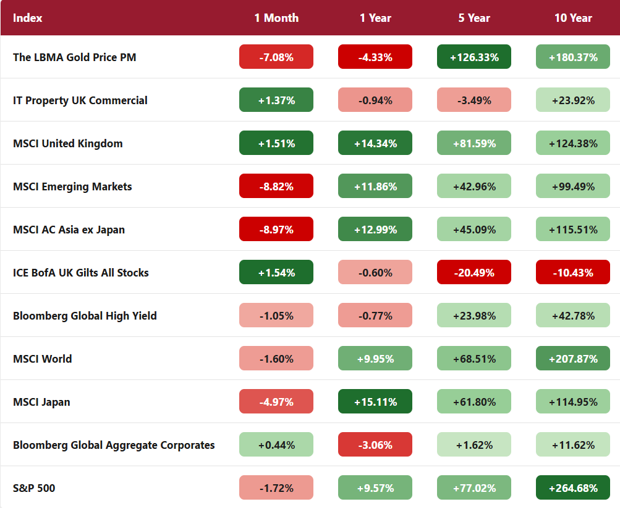
All performance figures are from FE analytics (as at 31/10/2026) and quoted on a total return basis in pounds sterling.
The Monthly Market Commentary (MMC) is written and researched by Scott Bradshaw, Lauren Hyslop and Jonathon Marchant for clients and professional connections of Mattioli Woods and is for information purposes only. It is not intended to be an invitation to buy, or to act upon the comments made, and all investment decisions should be taken with advice, given appropriate knowledge of the investor’s circumstances. The value of investments and the income from them can fall as well as rise and investors may not get back the full amount invested. Past performance is not a guide to the future.
Mattioli Woods Limited is authorised and regulated by the Financial Conduct Authority.
Sources: All other sources quoted if used directly, except fund managers who will be left anonymous; otherwise, this is the work of Mattioli Woods.
You may also like

Mattioli Woods renews Leicester Tigers partnership

Monthly Market Commentary – August 2026

Care costs dominate retirement concerns with most over-55s unprepared for Inheritance Tax hit
No results match your filters. Try a different tab or category.