
Businesses
Financial Planning for Business Owners
Building a successful business is only part of the journey.

How does business success become personal financial security?
Many business owners spend years building value. They grow revenues, create opportunities, take risks and invest enormous amounts of time and energy in making their business successful. Yet planning for their own financial future often receives far less attention.
For many owners, a significant proportion of their wealth remains tied up within the business. Future financial security may depend on ongoing profitability, future growth or the eventual value of an exit, making the business both their greatest asset and their greatest financial risk.
That creates important decisions around extracting profits, building wealth outside the business, retirement planning, tax efficiency and succession.
At Mattioli Woods, we help business owners connect business success with personal financial goals through joined-up financial planning built around clarity, expertise and long-term thinking.
Building a successful business is only part of the journey. Turning that success into lasting financial security is what comes next.
Building personal wealth from business success
Running a successful business often means focusing on growth, profitability, people and operations. As a result, personal financial planning can easily become a secondary consideration. Yet some of the most important financial decisions a business owner will make sit outside the business itself.
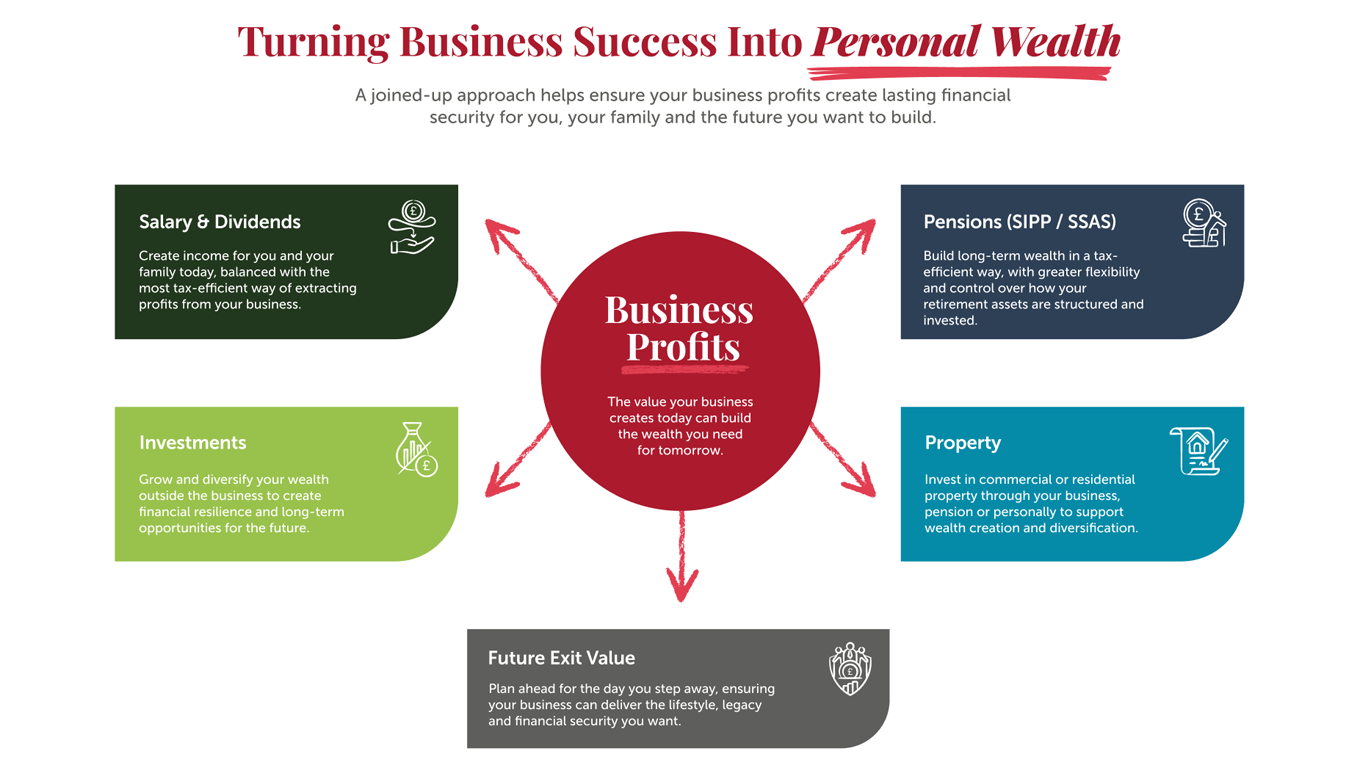
Financial planning helps connect business success with personal objectives by addressing questions around wealth creation, retirement, succession and long-term financial security. It also helps business owners consider how best to extract value from their business through a combination of salary, dividends, pension contributions, retained profits and investment strategies.
By aligning remuneration decisions with broader financial goals, business owners can often improve tax efficiency, create greater flexibility and build wealth alongside business growth. Ultimately, the goal is not simply to build a successful business, but to turn that success into lasting financial freedom, security and opportunity.
Helpful Tools
Tools that bring your plan to life
Better understand your financial position with our helpful tools
Helping business owners think more clearly about the future
One of the greatest benefits of financial planning is creating clarity.
Business owners often face competing priorities between business growth, family commitments, tax efficiency, wealth accumulation and future retirement plans.
Using cash-flow modelling and structured financial planning, we help clients understand how different decisions today may influence future outcomes.
This may involve understanding whether retirement remains achievable, whether wealth accumulation is sufficient, how a future business sale could affect long-term financial security or how personal and business wealth work together.
Financial planning helps transform uncertainty into informed decision-making.
The Mattioli Woods approach
More than 35 years of experience has taught us that business owners face financial planning challenges that are often very different from those of employees.
In fact, Mattioli Woods was originally built helping business owners navigate the complex financial decisions that come with building and running successful businesses. That heritage remains an important part of who we are today.
Business and personal finances frequently overlap. Decisions made within the business can have significant implications for personal wealth, retirement planning, tax efficiency and family security.
That’s why our approach brings together financial planning, tax planning, pensions, investment management, business protection and succession planning within one joined-up framework.
Today, more than 200 salaried advisers support over 30,000 clients across the UK and advise on more than £25 billion of assets.
Our advisers are supported by specialists across pensions, investments, tax planning, employee benefits and corporate services, helping ensure business owners have access to the expertise required as their circumstances evolve.

FAQs
Frequently asked questions
How should I pay myself from my business?
There is rarely a single answer to this question.
The most appropriate approach will depend on factors such as your income requirements, business profitability, future plans and prevailing tax legislation. Salary, dividends, pension contributions and retained profits may all play a role within an effective remuneration strategy.
The key is ensuring that decisions support both your current lifestyle and your longer-term financial objectives. What works well for one business owner may not be appropriate for another, which is why remuneration planning is often most effective when considered alongside wider financial planning.
Should I invest through my company or personally?
Both approaches can offer advantages depending on your circumstances.
The most suitable structure may be influenced by factors such as tax treatment, access to capital, succession objectives, future business plans and personal financial goals.
For some business owners, retaining surplus profits within the company may be appropriate. For others, extracting funds and investing personally may provide greater flexibility or support wider wealth planning objectives.
The right solution is often determined by what you are ultimately trying to achieve rather than by tax considerations alone.
What is a SSAS?
A small self-administered scheme (SSAS) is a type of occupational pension scheme often used by business owners, directors and family businesses.
Unlike many traditional pension arrangements, a SSAS can offer additional flexibility and control, allowing members to play a greater role in how the scheme is managed and invested.
Depending on individual circumstances, a SSAS may support a range of planning opportunities, including pension funding strategies, commercial property ownership and wider succession planning objectives.
Mattioli Woods has a long heritage in SSAS administration and helping business owners understand where these arrangements may fit within a broader financial plan.
How can pension contributions benefit business owners?
Pensions can be one of the most effective ways for business owners to build wealth outside of their company while creating valuable tax planning opportunities.
Employer pension contributions are often treated differently from salary or dividends and can provide a highly tax-efficient route for extracting value from a business.
Beyond the immediate tax benefits, pensions can help create long-term financial independence by building assets that sit separately from the future value of the business itself.
For many business owners, pension planning forms an important bridge between business success and future retirement security.
When should I start planning my exit from the business?
Ideally, exit planning should begin several years before any anticipated sale, succession event or reduction in involvement.
Early planning can help maximise business value, improve tax efficiency and create greater flexibility around how an eventual transition is structured.
Perhaps more importantly, it provides time to answer some of the wider questions that often accompany an exit:
How much wealth is enough? What will retirement look like? How should proceeds be invested? What role, if any, will the business continue to play in your future?
The most successful exits are rarely last-minute decisions. They’re the result of careful planning undertaken well before the exit itself takes place.