





Global markets summary
Global markets opened the year with equity indices reaching fresh peaks in January, driven by a notable broadening beyond US mega-caps. Asia Pacific markets excluding Japan surged 6.05% as international capital flowed towards emerging economies, while UK equities advanced 3.07% among developed markets, supported by attractive valuations.
Yet political tensions from Washington cast a shadow over markets mid-month. President Trump’s aggressive posturing, from Greenland threats to confrontational rhetoric towards Venezuela and Iran, signalled willingness to exercise American power without restraint. These manoeuvres, alongside reports of Department of Justice scrutiny involving Federal Reserve Chair Jerome Powell, unsettled sentiment. Tariff threats targeting Europe reignited trade tensions, prompting defensive rotation as volatility surged. The subsequent recovery left investors reassessing convictions rather than celebrating gains.
Within this environment, the broadening theme persisted. While the US market rose modestly in local currency terms, dollar weakness delivered a -0.59% return on the S&P 500 for sterling-based investors. Technology giants faced persistent questions about artificial intelligence (AI) investment sustainability, while smaller US companies enjoyed a strong start. Sterling strengthened nearly 2% against the dollar, underscoring its evolving role as a political risk barometer. Gold surpassed $4,960 per ounce to establish new record highs during January, although we have seen some recent profit taking since then as President Trump’s nomination of Kevin Warsh (viewed as an orthodox choice) as next Federal Reserve Chair eased concerns about looser monetary policy under Jay Powell’s successor – concerns that had been propelling precious metals higher.
Bond markets exhibited relative stability. UK gilts traced a volatile path but finished unchanged, while 10-year US Treasury yields rose modestly to 4.26%. Corporate bonds outperformed government debt, with high-yield issues particularly resilient.
Within our multi-asset funds, we remain cautiously optimistic. Defensive elements, including higher cash weightings and physical gold exposure, have provided valuable protection during volatility. Our tactical overweight to UK equities and underweight to US stocks has proven beneficial, capturing domestic strength while reducing exposure to mega-cap technology concerns and dollar weakness.
February will prove instructive. Earnings guidance may matter more than headline results as markets seek assurance on profit margin resilience. Geopolitical developments and policy signals will continue driving sentiment, determining whether January’s volatility represents temporary disruption or a more sustained pattern for the quarter.
United Kingdom
The UK equity market made an encouraging start to 2026, with several near-term catalysts pointing towards improved prospects for domestic equities, particularly within the small- and mid-cap segments for the year ahead.
Recent economic data has surprised to the upside. November GDP expanded +0.3%, exceeding consensus expectations of +0.1%, while the UK Composite PMI accelerated to 53.9 in December from 51.4 in November 2023; the fastest pace in two years, suggesting a release of pent-up demand from the Budget. Retail sales rebounded +0.4% in December, snapping two months of declines, and consumer sentiment improved modestly with GfK confidence rising to -16. These indicators collectively suggest the economy has weathered the storm and could be beginning to regain momentum.
Inflationary pressures remain elevated, with headline CPI at +3.4% in January, though core inflation held steady at +3.2%. Crucially, this is expected to fall sharply by the middle of the year to around 2%. Shop price inflation reached +1.5%, the highest since early 2024. However, private sector wage growth has moderated to +3.6%, while mortgage affordability has improved materially and stands close to the long-run average. With the Bank of England expected to resume its easing cycle in spring, declining borrowing costs should support consumption and housing activity through 2026.
The case for small- and mid-cap companies appears increasingly compelling. Valuations remain at historically wide discounts to large caps and lower interest rates would be particularly supportive for this area of the market. Critical near-term tailwinds include the absence of major new fiscal measures and the decreased attractiveness of saving, leading to higher consumer spending. Additionally, the lagged effect of prior interest rate cuts should deliver fuller economic benefits throughout 2026. Historically, small- and mid-cap recoveries have proven sharp when materialising, and investors remain well-placed to capture potential outsized returns should this rotation materialise in 2026.
North America
American equity markets eased into 2026 with a composed, steady stride despite a barrage of political noise. The S&P 500 gained 1.4% in dollar terms, yet the picture looked softer from a UK perspective: sterling’s strength trimmed those gains into a modest –0.59% once translated back into pounds. It was a reminder that even when markets behave, currency can quietly reshape the story.
One of the most reassuring features of the recent market environment has been the broadening of leadership, a trend that has been quietly building for several months. After years in which a small elite of mega-cap technology names carried the entire market on their shoulders, the closing months of 2025 and the start of 2026 have seen a noticeable redistribution of momentum. Smaller companies, value‑tilted sectors and more economically-sensitive businesses have been steadily contributing to returns. January did not mark the beginning of this trend, but rather its continuation, the latest chapter in a gradual shift towards a healthier, more inclusive market structure.
Technology earnings added nuance rather than uniform direction. Meta impressed with results that reinforced the strength of its underlying business, while Microsoft stumbled as concerns surfaced around the trajectory of its cloud division. Rather than unsettling markets, this divergence signalled something constructive: investors have returned to discriminating between companies on fundamentals, rewarding proven delivery rather than simply backing scale or narrative.
Economically, the month delivered a patchwork of signals. Inflation continued to cool, with core prices rising at their slowest pace in nearly four years, a welcome sign for policymakers and investors alike. Retail spending surprised to the upside, yet consumer confidence slid to a twelve‑year low, illustrating the ongoing tension between how consumers feel and how they behave. The Federal Reserve held interest rates steady and showed little appetite to move quickly in either direction. President Trump’s appointment of Kevin Warsh introduced political intrigue, but little in the way of immediate policy consequence.
Politically, though, January was anything but dull. Mid-month, markets were jolted by a flurry of presidential remarks on credit card rate caps, tariffs, and geopolitics. In a matter of hours, the S&P 500 gave up more than 2% and gold surged to fresh highs, reminding investors that politics can still trump economics … at least temporarily. These episodes were sharp but short-lived, fading as quickly as they arrived.
Despite these swings, January ultimately offered a measured, quietly constructive start to the year. Market gains were modest, but the composition of those gains, spread across more companies, more sectors, and more styles, continues to signal a more resilient foundation than we have seen in some time. The economic backdrop remains broadly supportive, even if political noise and geopolitical uncertainty will require continued vigilance.
Against this backdrop, we maintain a modestly reduced allocation to US equities, directing incremental capital towards markets that currently offer a more compelling blend of valuation and opportunity. Within the US, our exposure continues to look beyond the headline index, with a focus on value‑oriented, smaller‑company and style‑diverse strategies, the very areas that have been contributing to the market’s broadened leadership for several months, and where we believe the most attractive long‑term opportunities continue to lie.
Europe
European equities stepped into 2026 with quiet assurance. The year opened on a strong note, with major indices pushing to fresh highs and carrying forward the momentum that defined the closing months of 2025. As January unfolded, this strength revealed itself as something more substantial than seasonal optimism. European shares climbed steadily throughout the month, lifted by a compelling combination of encouraging corporate results, improving economic indicators and a return of confidence across the region.
Corporate earnings provided a solid foundation. Gains were broadly distributed across consumer, industrial and financial sectors, while pockets of strength in technology and select manufacturing names added welcome depth to the advance. The economic backdrop reinforced the positive narrative. Eurozone growth picked up pace, Germany delivered its first quarterly expansion in some time, and business sentiment moved decisively higher. Political uncertainties and geopolitical tensions remained in the background, yet markets chose to focus on fundamentals and the gathering economic recovery across the continent.
Perhaps the most encouraging feature was the breadth of the rally. Rather than depending on a handful of large names, January delivered gains across a wide spectrum of sectors, investment styles and company sizes. Banks, energy producers, industrials and consumer brands all contributed to the advance. Early strength in financials and energy seamlessly gave way to mid-month resilience in consumer and technology stocks. This broad participation created a more stable platform and offered reassurance to investors who value diversification over concentrated returns.
For sterling-based investors, currency movements worked quietly in their favour. The pound softened modestly against the euro during the month, trading within a narrow range that gently enhanced returns for unhedged UK investors holding European assets. In contrast to US exposures, where sterling strength diluted gains, European allocations benefited from benign currency dynamics that allowed the underlying equity performance to shine through.
January painted an encouraging picture. European markets began the year not with fanfare, but with balance and substance. The combination of steady economic progress, supportive earnings and broad market participation delivered a month that felt robust without appearing stretched. For sterling-based investors, healthy equity returns paired with favourable currency movements meant European allocations provided both early-year stability and a promising foundation for the period ahead.
Rest of the world
Japanese equities entered 2026 with a quiet confidence, continuing the steady revival that has been building over recent quarters. Corporate reforms, improved governance standards and a renewed focus on shareholder returns have made Japan feel less like the perennial value trap of old and more like a market rediscovering its purpose. January offered more of the same: a measured but reassuring advance, driven by industrials, autos and select technology names.
The yen remained weak, tempering equity gains once translated back into pounds, though the softer currency also amplified the competitiveness of Japanese exporters. What emerged was a month that felt balanced: modest headline returns, but with encouraging signals beneath the surface and an improving tone across earnings guidance. Most importantly, Japan’s market continued to benefit from a broadening of domestic participation, as small- and mid-cap companies added to the sense that this is no longer a market driven only by large-cap exporters. For long-term investors, this diversification of drivers is a welcome evolution.
Across the broader Asia Pacific region, January delivered a tapestry of contrasts. Australia and New Zealand enjoyed a calm start, with income generating sectors and financials contributing steadily. In contrast, parts of Southeast Asia saw more energetic trading, as improving tourism flows and domestic demand underpinned equity performance in markets such as Indonesia, Thailand and the Philippines.
China remained the region’s wildcard. While policymakers continued providing selective support to stabilise property markets and encourage domestic investment, investor sentiment remained cautious. Equities drifted rather than rallied, with markets responding more to policy tone than economic data. Still, the absence of fresh shocks (and faint signs of bottoming in some leading indicators) lent the month a more settled feel than much of last year.
Latin America was a standout, with Brazil and Mexico benefiting from a revival in consumer activity and improving fiscal sentiment. India continued its long running upward trajectory, still buoyed by strong internal demand, corporate investment and political stability ahead of its next electoral cycle. Meanwhile, markets exposed to commodity price volatility (particularly in Africa and parts of the Middle East) found some relief as energy prices stabilised through the month.
Sterling’s appreciation against a basket of EM currencies meant UK investors saw more subdued returns than local markets suggested. Even so, on a relative basis, EM equities offered diversification benefits at a moment when developed market volatility spiked intermittently. For investors seeking long-term growth drivers beyond the US and Europe, January reinforced the view that emerging markets remain an essential (if inherently uneven) component of global portfolios.
Fixed income
Fixed income markets began 2026 in notably calmer fashion. Central banks chose patience over provocation. Both the Bank of England and the Federal Reserve held policy rates steady through January. This gave investors time to reassess without policy surprises. The pause reflected a desire to let previous cuts settle, observe data, and avoid adding noise to sensitive markets.
In the UK, the Bank of England remained cautious, balancing easing inflation against resilient economic activity. Markets expected further rate cuts later in the year, but January brought no near-term shift. Gilt markets rallied early in the month. Yields fell across the curve, with longer maturities leading. Softer inflation expectations and signs of shorter Government issuance helped. For sterling investors, gilts offered clear duration opportunities. Local rates moved meaningfully and currency effects did not erode returns.
US Treasuries spent much of January range bound. The Federal Reserve kept the funds rate unchanged and emphasised domestic economic strength alongside sticky inflation. Treasury markets drifted rather than surged. Ten-year yields oscillated within a tight band. For global investors, carry mattered far more than capital appreciation. The absence of surprise became its own form of stability.
Credit markets responded with composure. In sterling investment grade, income did the heavy lifting. With gilt yields declining, spreads stable, and fundamentals supportive, sterling corporate bonds delivered steady returns. This is exactly what income investors seek at this stage of the cycle. The theme was similar globally. Investment grade spreads remained tight by historical standards, but elevated government yields kept all-in yields attractive. Issuance picked up, dispersion widened, and security selection mattered more than bold macro calls.
High yield found a similar rhythm, though with a distinct flavour. After two years of strong performance, valuations left little room for further spread compression. January set the tone for what is likely to be a carry year, defined by coupon collection rather than price appreciation. Income levels remain appealing, but the market is now more discerning. Balance sheet quality, refinancing profiles, and sector risks are gaining influence over performance. The environment rewards thoughtful exposure rather than directional enthusiasm.
Emerging market debt extended the quiet resilience it showed in late 2025. Softer inflation across many EM economies, improving policy stability, and a less dominant US dollar created favourable conditions. January did not produce outsized moves, but that was precisely the point. Returns were positive, measured, and encouraging. After a strong prior year, the asset class appears to be moving from rebound to consolidation, with fundamentals still offering support.
Ask us anything
Q: Recently I’ve read several articles that predict doom across global markets and the economy – what’s your perspective on this?
As we move into 2026, headlines often emphasise risks; geopolitical tensions, uneven growth and stretched valuations in technology. Yet beneath these concerns lies a more constructive reality. The global economy has shown surprising resilience, and credible data suggests conditions are more supportive than news flow implies.
Despite persistent uncertainty, global economic growth remains solid. The IMF projects global growth of about 3.3% in 2026, a slight upward revision supported by strong investment in artificial intelligence, accommodative financial conditions and improving trade dynamics. Inflation is expected to moderate further, with global headline inflation forecast to fall from 4.1% in 2025 to 3.8% in 2026, easing pressure on consumers and giving central banks more flexibility.
This resilience is not confined to one region. The US continues to exceed expectations, with growth lifted by investment in technology infrastructure and fiscal support. The IMF has raised its forecast for US growth in 2026 to about 2.4%. China and India remain powerful contributors, jointly accounting for nearly half of projected global growth in 2026, supported by policy easing and stable domestic demand.
Several major institutions expect the current equity cycle to continue at a more measured pace. Goldman Sachs describes the outlook for 2026 as one of “sturdy” global growth, with expectations for global equities to benefit from easing financial conditions and continued earnings expansion. Morgan Stanley highlights structural themes such as AI adoption, energy transition and shifting supply chains as enduring sources of opportunity, noting that thematic investment strategies significantly outperformed global indices in 2025 and are expected to remain influential in 2026.
International markets also look competitive. Improvements in policy frameworks, fiscal support in parts of Europe and Japan, and broadening earnings growth beyond US mega-cap technology firms are creating a more balanced global investment environment. The IMF notes that technology investment is increasingly lifting activity in Europe and parts of Asia, providing diversification benefits.
Inflation is moving steadily closer to central bank targets across advanced economies. The OECD reports that headline inflation has returned to target in nearly half of advanced economies and that real household incomes are beginning to recover as wage growth outpaces price increases, improving the backdrop for consumer spending and economic stability. Labour markets, while softening slightly from post-pandemic tightness, remain strong by historical standards. This stability supports employment and household confidence, helping cushion the impact of higher interest rates.
Genuine risks still exist. The IMF and OECD warn that global growth remains uneven, with some economies facing structural challenges and geopolitical developments continuing to pose threats to supply chains and energy markets. Markets may also be vulnerable to volatility if enthusiasm for AI-related investments normalises or if trade tensions flare up. However, these risks are well understood and less likely to surprise markets, and policymakers have shown increasing willingness to respond in a coordinated way.
Financial news highlights shocks and downturns because these make compelling stories. Research by Ciccone and Rusche1 found that while major equity indices in the US and Europe rose between 2017 and 2024, the days selected for reporting tended to coincide with market declines, making the picture look gloomier than the underlying trend. Further research confirms each negative word in a headline increases click-through rates by over 2%, reinforcing editorial incentives to focus on downside rather than steady progress. This structural bias distorts investor perception, amplifying anxiety and underplaying factors that support global markets.
When viewed through daily headlines, 2026 can appear fraught with risk. Yet the evidence from credible global institutions tells a more reassuring story. Economic growth is holding up better than many expected. Inflation is falling. Labour markets are stable. Investment in transformative technologies is accelerating. Diversified global portfolios are benefiting from a broader base of economic activity.
For long-term investors, the picture is one of cautious optimism. Markets will continue to experience periods of volatility, but the foundations for sustainable global growth remain intact. A calm, long-term approach grounded in data rather than headlines continues to offer the most reliable path forward.
If there is a question you’d like to pose to our team, please reply to this email or write to [email protected].
Four key takeaways from January:
- Equity leadership expanded across smaller companies, value stocks, and more economically-sensitive sectors globally, signalling a healthier and more inclusive market structure.
- UK equities advanced 3.07%, supported by better-than-expected economic data, attractive valuations, and compelling prospects for small- and mid-cap companies trading at historically wide discounts.
- President Trump’s aggressive rhetoric and tariff threats created sharp mid-month volatility, but markets recovered quickly as investors refocused on fundamentals rather than political noise.
- Both the Bank of England and Federal Reserve held rates steady through January, creating a calm environment where credit markets delivered steady income-driven returns rather than capital appreciation.
MARKET DATA
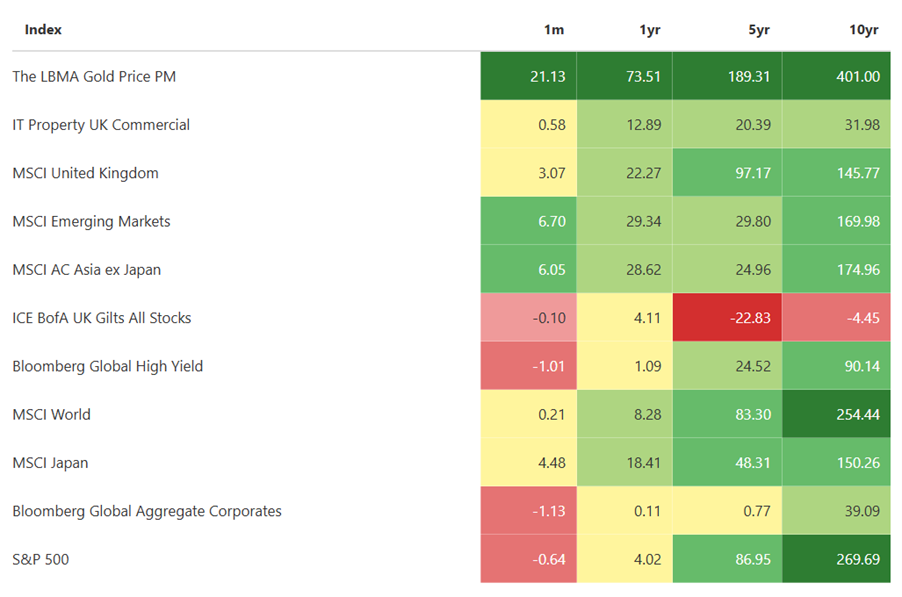
All performance figures are from FE analytics (as at 31/01/2026) and quoted on a total return basis in pounds sterling.
The Monthly Market Commentary (MMC) is written and researched by Scott Bradshaw, Lauren Hyslop and Jonathon Marchant for clients and professional connections of Mattioli Woods and is for information purposes only. It is not intended to be an invitation to buy, or to act upon the comments made, and all investment decisions should be taken with advice, given appropriate knowledge of the investorʼs circumstances. The value of investments and the income from them can fall as well as rise and investors may not get back the full amount invested. Past performance is not a guide to the future.
Mattioli Woods Limited is authorised and regulated by the Financial Conduct Authority.
Sources: All other sources quoted, if used directly, except fund managers who will be left anonymous; otherwise, this is the work of Mattioli Woods.