

For many investors, financial returns are only part of the picture.
Increasingly, investors want their portfolios to reflect broader environmental, social and governance considerations alongside their long-term financial goals and wider planning priorities.
At Mattioli Woods, we believe responsible investing should form part of a thoughtful and disciplined investment process – considering not only traditional financial risks and opportunities, but also the wider structural trends shaping economies, industries and societies over time.
Our responsible investing capabilities are designed to help clients incorporate ESG considerations into investment decisions while remaining aligned to their wider investment objectives, attitude to risk and long-term financial plans.
Because responsible investing is not simply about exclusions, labels or avoiding certain sectors.
It is about understanding how businesses are managed, how risks are identified, how companies adapt to change and how investment decisions are made for the long term.
What is responsible investing?
Responsible investing is an approach to investing that incorporates environmental, social and governance (ESG) considerations alongside traditional financial analysis and investment decision-making.
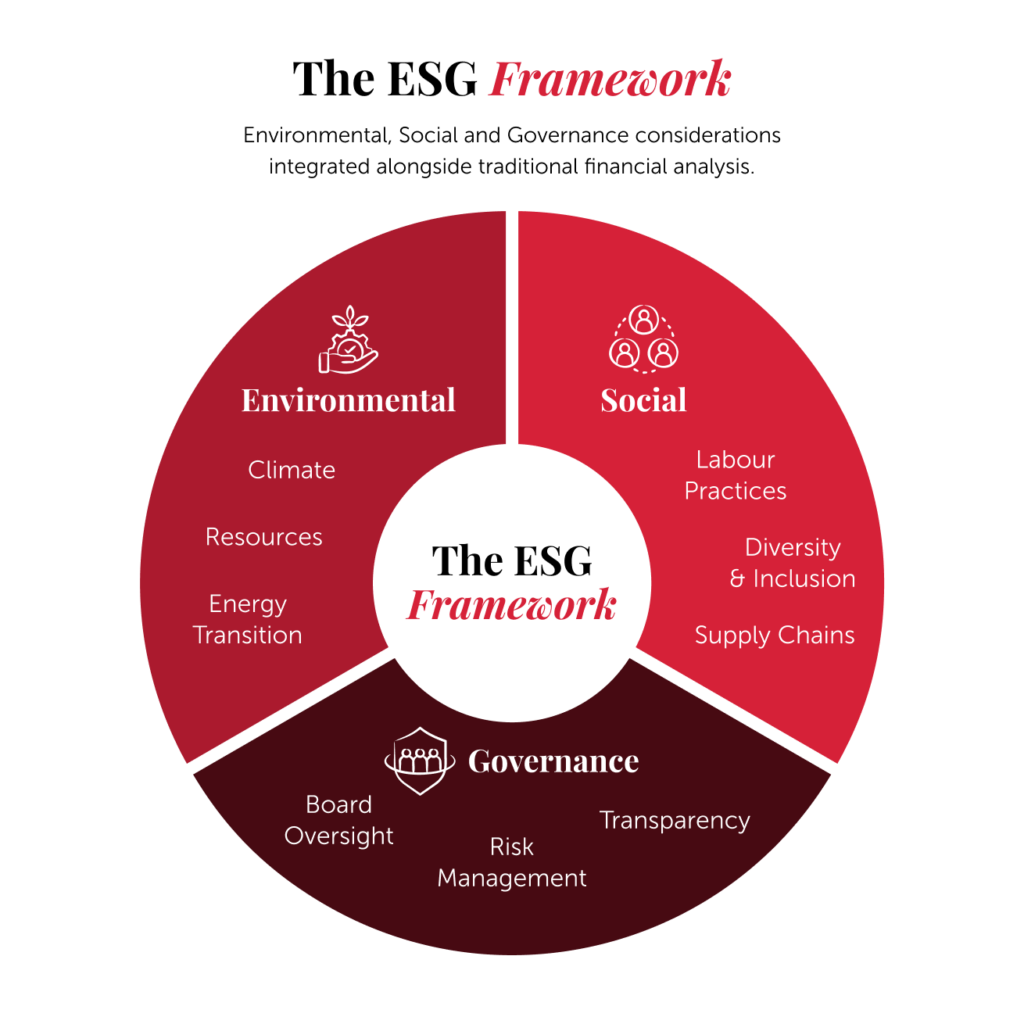
The framework below highlights some of the key themes commonly considered within responsible investment approaches.
For many investors, responsible investing is not solely values-driven. It can also form part of a broader assessment of how businesses manage long-term operational, regulatory and reputational risks.
Different investors will place different levels of emphasis on ESG considerations, which is why responsible investment approaches can vary significantly between portfolios and investment managers.
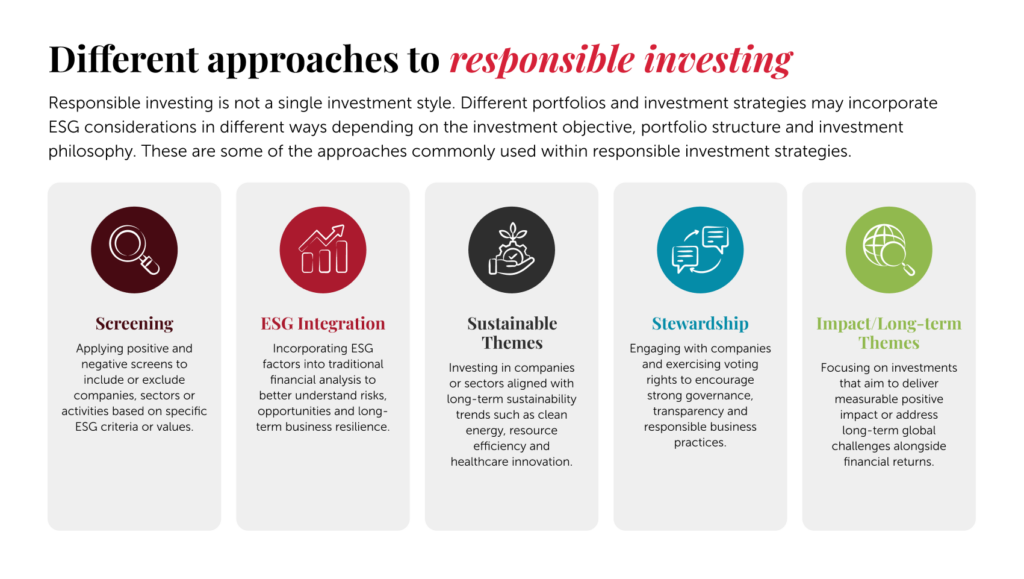
Responsible investment approaches
Screening
Applying positive and negative screens to include or exclude companies, sectors or activities based on specific ESG criteria or values
ESG integration
Incorporating ESG factors into traditional financial analysis to better understand risks, opportunities and long-term business resilience
Sustainable themes
Investing in companies or sectors aligned with long-term sustainability trends such as clean energy, resource efficiency and healthcare innovation
Stewardship
Engaging with companies and exercising voting rights to encourage strong governance, transparency and responsible business practices
Impact/long term themes
Focusing on investments that aim to deliver measurable positive or address long-term global challenges alongside financial returns
Some strategies may exclude specific sectors or activities. Others may focus on identifying businesses demonstrating stronger governance, sustainability or long-term operational resilience.
This flexibility helps ensure responsible investment approaches remain aligned to differing client objectives, values and financial priorities.
ESG managed portfolios
Sustainable portfolio solutions through iBOSS
Responsible investment approaches are available within the iBOSS Managed Portfolio range, including sustainable investment portfolios designed for clients who wish to incorporate environmental, social and governance (ESG) considerations into their investment decisions alongside wider financial objectives and risk considerations.
These portfolios aim to balance long-term investment returns with broader sustainability considerations through diversified multi-asset portfolio construction and ongoing investment oversight.
Depending on the portfolio selected, this can include:
- ESG-focused portfolio construction
- Responsible investment screening
- Sustainable investment themes
- Diversified multi-asset investing
- Ongoing portfolio oversight and governance
The investment process combines third-party ESG research alongside additional qualitative assessment and portfolio oversight, helping ensure sustainability considerations are assessed alongside broader investment risks, opportunities and portfolio objectives.
Because sustainable investing can involve differing personal preferences and interpretations, transparency and suitability remain particularly important. Investors and advisers therefore benefit from ongoing portfolio insights, investment commentary and reporting designed to provide greater clarity around portfolio positioning, sustainability characteristics and underlying holdings.
This approach helps create diversified sustainable portfolios designed not only around ESG considerations, but also around long-term portfolio resilience, diversification and disciplined investment management.
Bespoke responsible investment management
For clients seeking a more personalised responsible investment approach, Mattioli Woods Private Client – Bespoke can incorporate ESG and sustainability considerations within discretionary investment management and wider portfolio construction.
This allows investment strategies to be tailored more closely around:
- Individual sustainability preferences
- Responsible investment priorities
- Portfolio exclusions and screening requirements
- Long-term financial objectives
- Wider wealth planning considerations
Depending on the mandate agreed, portfolios can incorporate ESG-focused investments, sustainable investment themes and responsible investment screening alongside broader diversification, risk management and portfolio management considerations.
Because responsible investing is often highly personal, a bespoke investment approach can provide greater flexibility around how sustainability considerations are incorporated within a wider investment strategy.
Responsible investing and financial planning
Responsible investing should not be viewed in isolation from wider financial planning.
For some investors, ESG considerations may form a central part of portfolio design. For others, they may represent one factor among a broader range of investment, tax and financial planning considerations.
A Mattioli Woods adviser can help determine how responsible investment approaches may fit within:
- Retirement planning
- Pension investing
- Long-term wealth planning
- Portfolio diversification
- Risk management
- Intergenerational planning
This joined-up approach helps ensure investment decisions remain aligned to wider financial priorities and long-term planning objectives.
Understanding ESG considerations and investment risk
Like all investments, responsible investment strategies involve investment risk and investment values can fall as well as rise.
It is also important to recognise that ESG investing does not follow a single universal definition. Different investment managers and portfolios may apply ESG considerations in different ways and to differing degrees.
As a result, responsible investment approaches can vary significantly between portfolios and investment managers. ESG criteria and sustainability frameworks may also evolve over time, portfolio exclusions can differ between strategies and financial returns are not guaranteed. Because of this, understanding how ESG considerations are incorporated within an investment strategy remains an important part of the investment selection process.
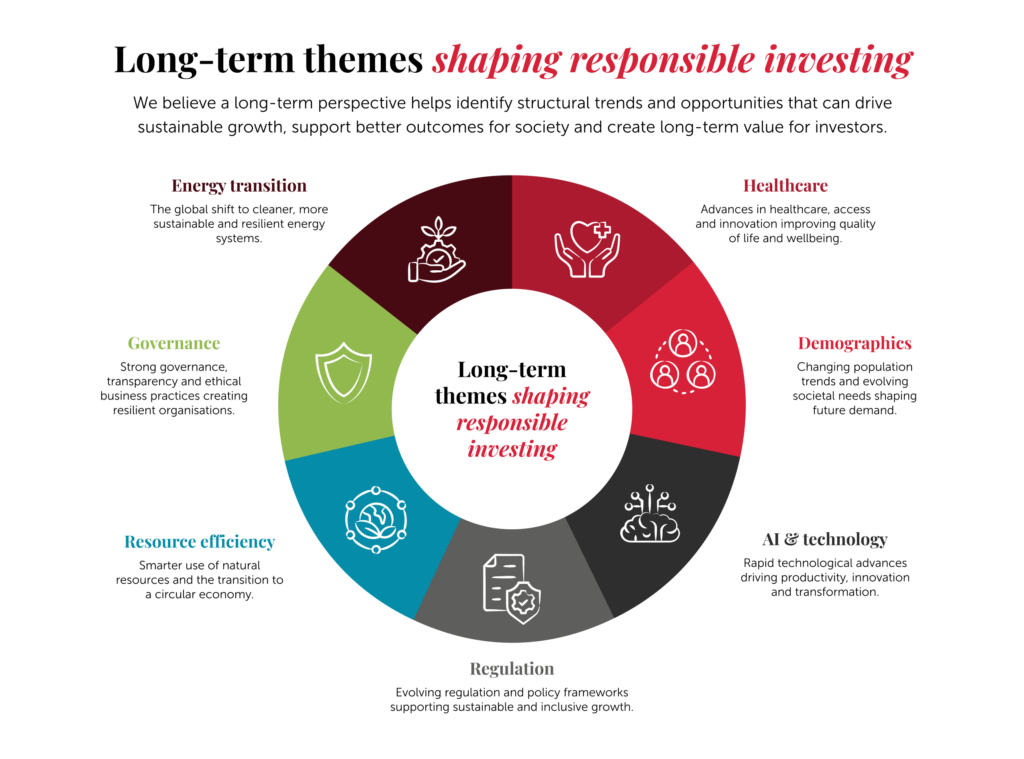
Long-term themes shaping responsible investing
For many investors, responsible investing provides a framework for considering how these broader long-term themes may influence investment opportunities and risks over time.
Investment governance and oversight
Responsible investment portfolios remain subject to the same disciplined governance, oversight and portfolio management processes as wider investment solutions.
As illustrated below, responsible investing is not a static process. Portfolios are continuously researched, reviewed and monitored to help ensure ESG considerations remain integrated within the broader investment process alongside financial analysis, risk management and long-term investment objectives.
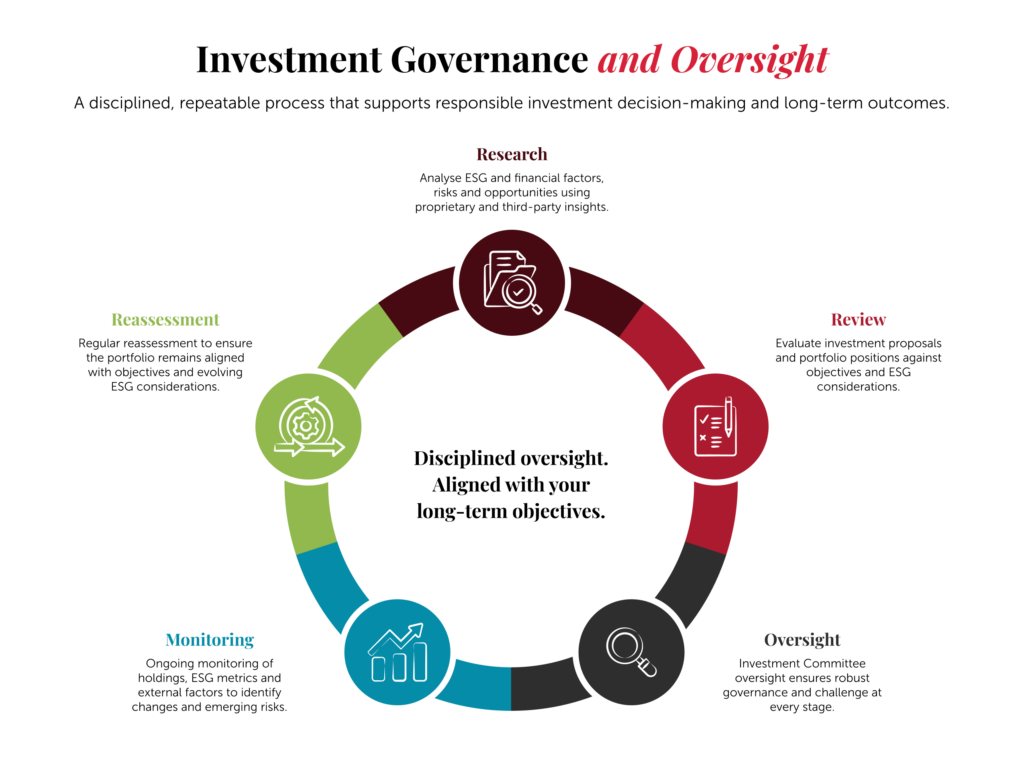
As illustrated above, responsible investing is not a static process. Portfolios are continuously researched, reviewed and monitored to help ensure ESG considerations remain integrated within the broader investment process alongside financial analysis, risk management and long-term investment objectives.
This ongoing governance framework incorporates:
- Investment research and analysis
- Portfolio review and challenge
- Investment committee oversight
- Ongoing monitoring of holdings and market developments
- Regular reassessment of portfolio positioning and ESG considerations
This disciplined and repeatable approach helps ensure portfolios remain aligned to their stated objectives, portfolio mandates and evolving market conditions while maintaining transparency, diversification and long-term investment discipline.
FAQs
Frequently asked questions
Does responsible investing mean sacrificing investment returns?
Not necessarily. Many responsible investment approaches aim to balance ESG considerations alongside broader financial objectives and investment performance considerations.
However, investment outcomes will always depend on market conditions, portfolio construction and the investment strategy selected.
Are ESG investments lower risk?
Not automatically. ESG investments remain subject to market risk and investment values can fall as well as rise. ESG considerations form one part of the wider investment process rather than removing investment risk altogether.
Can responsible investing form part of retirement planning?
Yes. Responsible investment strategies can be incorporated within wider retirement planning and long-term investment strategies where appropriate.
Are sustainable portfolios available through managed portfolios?
Yes. Sustainable and ESG-focused investment approaches are available within the iBOSS Managed Portfolio range.