

Successful investing is about more than choosing investments. It’s about creating a disciplined strategy designed around your life, your ambitions and the future you want to build.
At Mattioli Woods, our investment management services combine institutional investment expertise with personal financial planning to help clients invest with greater clarity and confidence.
Whether you’re seeking diversified portfolio management, bespoke discretionary investment management, responsible investing, private market opportunities or treasury solutions, our investment proposition is designed to provide structured, actively governed investment solutions tailored to different client needs.
Because successful investing is rarely about a single solution. It’s about combining the right expertise, investment approaches and discipline to support your wider financial goals.
Successful investing isn’t about finding a single investment answer. It’s about combining the right expertise, structure and long-term discipline to support clients through changing markets and evolving financial goals.

Investing with confidence
Investing plays an important role in helping individuals, families and organisations protect and grow wealth over time.
While cash savings provide security for short-term needs and emergency reserves, inflation can reduce the long-term purchasing power of money held purely on deposit. Saving protects wealth. Investing puts it to work – providing the opportunity for growth, income generation and wealth preservation through diversified portfolio management.
At Mattioli Woods, we believe successful investing begins with understanding:
- Your financial goals
- Your investment time horizon
- Your attitude to risk
- Your income requirements
- Your tax considerations
- Your wider financial planning priorities
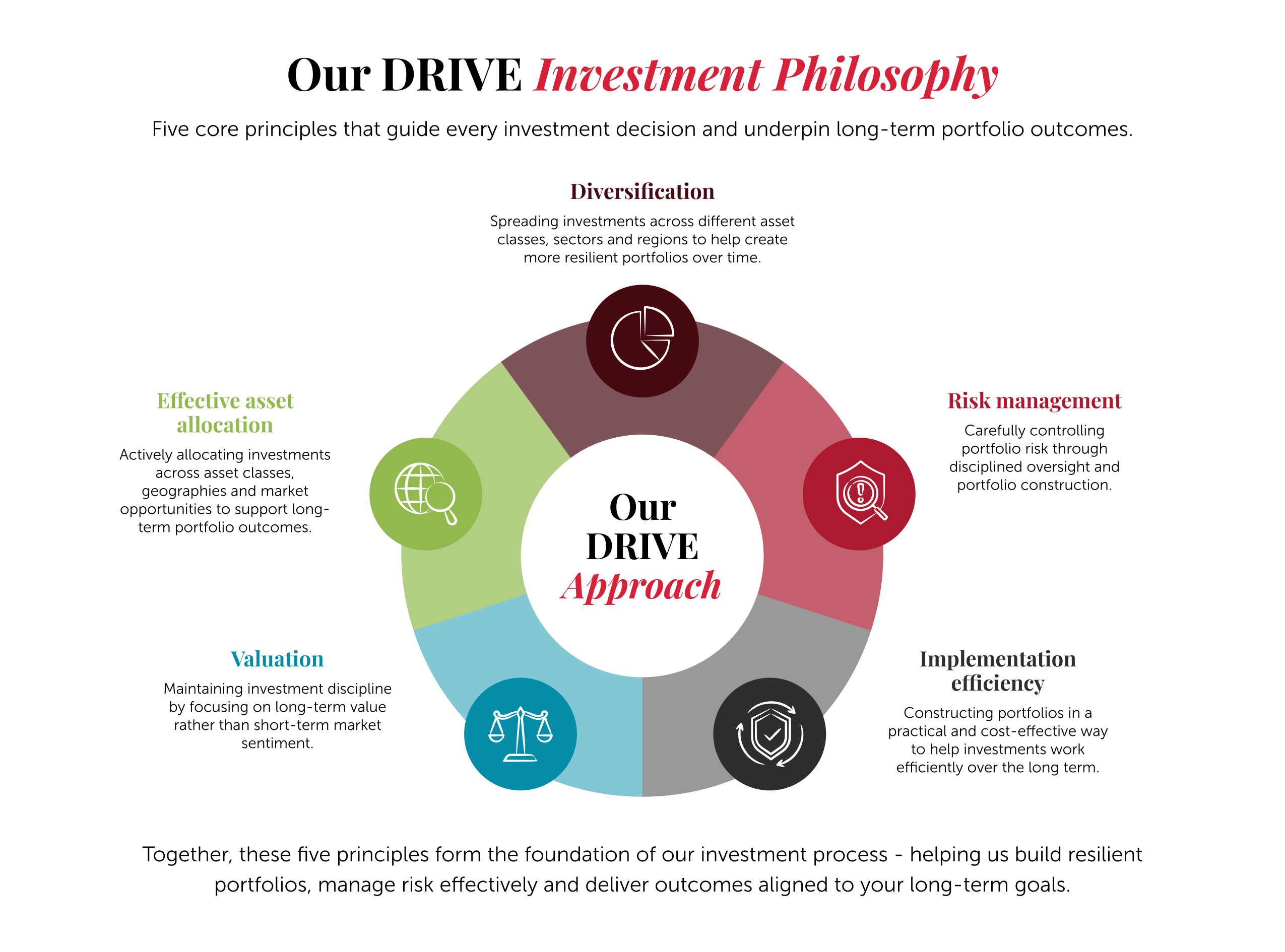
Our investment philosophy is built around five core principles which together form our DRIVE approach:
Diversification
Spreading investments across different asset classes, sectors and regions to help create more resilient portfolios over time.
Risk management
Carefully controlling portfolio risk through disciplined oversight and portfolio construction.
Implementation efficiency
Constructing portfolios in a practical and cost-effective way to help investments work efficiently over the long term.
Valuation
Maintaining investment discipline by focusing on enduring value rather than short-term market sentiment.
Effective asset allocation
Actively allocating investments across asset classes, geographies and market opportunities to support long-term portfolio outcomes.
A structured investment ecosystem
Different investors require different investment solutions.
Some clients prioritise diversified long-term growth. Others seek lower-cost passive investing, tactical portfolio management, responsible investing, retirement income, Inheritance Tax planning (IHT) or bespoke discretionary investment management.
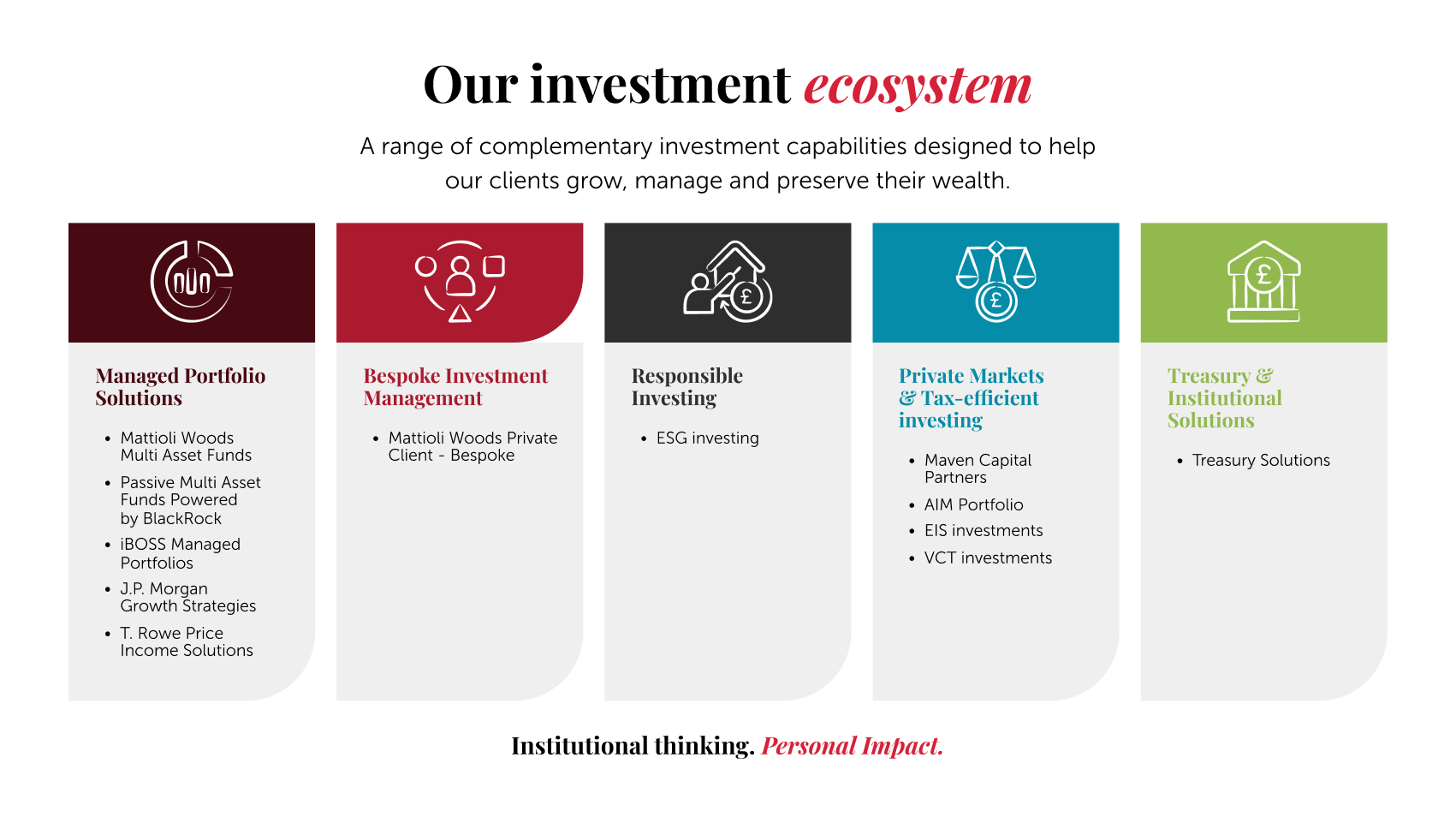
That’s why our investment proposition is built around a carefully structured ecosystem of complementary investment capabilities.
Together, these capabilities provide you and your adviser access to diversified portfolio management, institutional investment expertise and specialist investment opportunities within a disciplined governance framework.
Managed Portfolio Solutions
Diversified investment solutions designed around different investment approaches
Our Managed Portfolio Solutions provide professionally managed, risk-rated portfolios designed to support different client objectives, attitudes to risk and implementation preferences.
Whether you prefer active portfolio management, passive investing or more outcome-focused investment strategies, our Managed Portfolio Solutions range provides access to carefully governed investment solutions built around disciplined investment principles.

Diversified active portfolios
Mattioli Woods multi-asset funds
The Mattioli Woods multi-asset funds are actively managed, risk-rated multi-asset portfolios designed to help grow wealth over the long term through diversified portfolio construction, disciplined strategic asset allocation and selective tactical positioning.
Available across four risk profiles:
- Cautious
- Balanced
- Growth
- Adventurous
The funds are managed by the Mattioli Woods in-house Investments team using our DRIVE investment philosophy.
Each portfolio combines long-term strategic asset allocation designed to align with its target risk profile, alongside tactical asset allocation decisions that allow portfolios to respond thoughtfully to changing market conditions and investment opportunities.
The portfolios utilise an open-architecture approach, combining specialist investment managers from around the world to create diversified portfolios designed to support long-term growth while carefully managing investment risk through changing market conditions.
This approach blends institutional investment expertise with the simplicity and accessibility of a single-fund investment solution.
iBOSS Managed Portfolio Solutions (MPS)
iBOSS provides a broad range of professionally Managed Portfolio Solutions designed for advisers and clients seeking a more tactical and dynamically managed investment approach.
The proposition includes:
- Core MPS
- Passive MPS
- Blended MPS
- Decumulation portfolios
- Sustainable investment portfolios
Together, this provides access to 41 risk-rated portfolios designed to support differing client objectives, investment styles and retirement needs.
Using active asset allocation, tactical portfolio positioning and ongoing market oversight, iBOSS portfolios are designed to respond proactively to changing market conditions while maintaining diversified multi-asset exposure within a disciplined investment framework.
Passive portfolio solutions
Passive multi-asset funds Powered by BlackRock
For clients seeking a lower-cost, index-based investment approach, our passive multi-asset funds Powered by BlackRock combine strategic portfolio design from Mattioli Woods with the scale and efficiency of BlackRock iShares funds.
Available across four risk profiles:
- Cautious
- Balanced
- Growth
- Adventurous
The portfolios provide diversified passive exposure across global equities, sovereign and corporate bonds, emerging markets and alternative assets.
Strategic asset allocation is overseen by the Mattioli Woods Investments team, helping ensure portfolios remain aligned to long-term objectives and risk parameters while benefiting from the transparency, scale and cost efficiency of passive investing through one of the world’s leading investment managers, BlackRock.
Outcome-oriented strategies
Atlas Strategies Powered by J.P. Morgan
Our investment proposition includes exclusive access to three globally diversified growth portfolios created specifically for Mattioli Woods by J.P. Morgan Asset Management.
Available across three different risk profiles, the portfolios are designed for clients seeking long-term capital growth through actively managed multi-asset investing.
Combining global research capability, institutional investment expertise and disciplined portfolio construction, the portfolios are designed to help clients access global growth opportunities through changing market conditions while remaining aligned to broader investment objectives.
T. Rowe Price income solutions
For clients seeking sustainable income alongside long-term capital management, our investment proposition includes income-focused portfolios created exclusively for Mattioli Woods clients by T. Rowe Price.
Available across two different risk profiles, the portfolios are designed to support retirement planning and long-term income generation through actively managed multi-asset investing.
Drawing on the global investment expertise and diversified portfolio construction capabilities of one of the world’s leading income managers, the portfolios aim to balance reliable income with long-term capital resilience through changing market conditions.
Successful portfolio management requires more than selecting investments. It requires disciplined asset allocation, careful risk management and the flexibility to adapt as markets evolve.

Bespoke investment management
Personal discretionary investment management tailored to you
For clients seeking a more personalised investment approach, Mattioli Woods Private Client – Bespoke delivers discretionary investment management tailored to individual financial priorities and long-term objectives.
Clients work directly with experienced investment managers to create portfolios tailored around:
- Wealth preservation
- Long-term growth
- Income generation
- Retirement planning
- Estate planning considerations
- Tax efficiency
- ESG preferences
- Intergenerational wealth planning
This relationship-led approach combines active portfolio management with wider financial planning considerations, helping ensure investment strategies remain aligned to the broader financial realities of a client’s life.
Solutions include:
- Bespoke discretionary portfolios
- ESG portfolios
- AIM Inheritance Tax portfolios
- Tax-aware portfolio management
Responsible investing
Investing with broader future-focused considerations
For many investors, financial returns are only part of the picture.
Increasingly, clients want their investments to reflect broader environmental, social and governance considerations alongside their long-term financial objectives.
At Mattioli Woods, we believe responsible investing should form part of a thoughtful and disciplined investment process – considering not only traditional financial risks, but also the wider structural trends shaping economies, businesses and societies over time.
Responsible investing solutions are available across multiple areas of our investment proposition, including:
- ESG managed portfolios
- Responsible discretionary investment management
- Sustainable investment strategies
- Responsible screening approaches
- Long-term thematic investing9
Because responsible investing is not simply about exclusions or labels.
It’s about aligning investments thoughtfully to wider long-term objectives, personal values and the future clients want, to help support through their investment decisions.
Private markets and tax-efficient investing
Specialist investment opportunities beyond traditional markets
Certain investors may wish to access specialist investment opportunities beyond traditional listed markets as part of a diversified long-term investment and wealth planning strategy.
At Mattioli Woods, our private markets and tax-efficient investment capabilities are designed for investors seeking access to alternative growth opportunities, specialist planning solutions and longer-term wealth structuring strategies.
Through Maven Capital Partners, qualifying investors can access specialist private market investment opportunities including:
- Private equity
- Venture capital
- Growth capital strategies
- Alternative investment opportunities
We also provide specialist tax-efficient investment solutions including:
- AIM portfolios through Mattioli Woods Private Client – Bespoke
- The Enterprise Investment Scheme (EIS)
- Venture Capital Trusts (VCTs)
- Unlisted Business Relief solutions (BR)
These solutions may support broader Inheritance Tax planning, tax-efficient investing and long-term wealth planning considerations where appropriate.
Private market and tax-efficient investments can provide access to businesses, sectors and growth opportunities not always available through traditional public markets. However, because these investments can involve higher levels of investment risk, reduced liquidity, longer investment horizons and greater complexity than traditional investments, careful suitability assessment and ongoing oversight remain essential.
Treasury and institutional solutions
Strategic treasury and liquidity management
Managing significant cash balances requires more than simply seeking competitive deposit rates.
Mattioli Woods Treasury Solutions provides bespoke treasury and liquidity management services for:
- Charities
- Universities
- Trusts
- Pension schemes
- Corporates
- Institutional investors
Our approach focuses on balancing security, liquidity, accessibility, risk management and yield optimisation within a disciplined treasury framework. Every treasury strategy is designed around the operational realities, governance structure and liquidity requirements of each organisation.
We work closely with organisations to help improve treasury oversight, operational efficiency and counterparty diversification, ensuring cash management strategies remain aligned to broader governance and financial objectives. Through disciplined oversight and institutional-grade treasury management, we help clients manage liquidity with greater clarity, control and confidence.
Effective treasury management is about balancing security, liquidity and return within a disciplined governance framework tailored to the needs of each organisation.

Investment management connected to financial planning
Investment decisions should never happen in isolation.
One of the strengths of the Mattioli Woods investment proposition is the ability to integrate investment management with wider financial planning and wealth management advice.
This may include:
- Retirement planning
- Pension strategies
- Cashflow modelling
- Estate planning
- Trust planning
- Income planning
- Tax-efficient investing
- Inheritance Tax (IHT) planning
This joined-up approach helps ensure investment strategies remain connected to your wider financial goals, life plans and priorities.
Your financial world in one place
Managing wealth should feel organised, transparent and accessible, particularly when investments form part of a wider financial plan.
Our digital tools and client technology solutions are designed to help clients maintain visibility over their investments and wider financial arrangements through secure online access and reporting.
Depending on the services used, clients can:
- View portfolio valuations
- Access reporting and documentation
- Monitor financial progress
- Communicate securely with advisers and investment managers
- Maintain oversight of wider financial planning arrangements
This includes access to digital solutions such as Mattioli Woods Go and MWeb, helping clients stay connected to their financial information with greater clarity and convenience.
Because investment management should feel transparent, accessible and connected to the wider financial decisions shaping your future.
Investment insights and market commentary
Successful investing requires ongoing oversight, perspective and communication – particularly through changing market conditions.
Our investment teams provide regular market commentary, portfolio insights and investment updates designed to help clients and advisers stay informed about market developments, economic trends, portfolio positioning, investment outlooks and long-term investment themes.
This includes:
- Monthly investment commentary
- Quarterly market updates
- Portfolio and fund reporting
- Investment webinars and events
- Specialist insights from our investment teams and external partners
Because investment management should not feel distant or opaque. It should provide ongoing clarity around how portfolios are being managed and why.
Explore our investment capabilities
Managed Portfolio Solutions
Diversified active and passive portfolio solutions designed around different risk profiles and investment approaches.
Bespoke investment management
Personal discretionary investment management tailored to individual financial priorities and long-term objectives.
Responsible and tax-efficient investing
ESG, AIM, EIS, VCT and Unlisted Business Relief investment solutions aligned to wider financial planning considerations.
Private markets
Specialist private equity and alternative investment opportunities through Maven Capital Partners.
Treasury and institutional solutions
Institutional treasury and liquidity management services designed around governance, security and flexibility.
FAQs
Frequently asked questions
What investment management solutions do Mattioli Woods provide?
Mattioli Woods provides a broad range of investment management solutions designed to support differing financial goals, investment preferences and levels of complexity.
Our offering includes:
- Managed Portfolio Solutions
- Bespoke discretionary investment management
- Active and passive investment strategies
- ESG and responsible investing solutions
- AIM, EIS, VCT and Unlisted Business Relief investing
- Private market investment opportunities
- Treasury and liquidity management services
We work with private clients, advisers, trustees and institutions to provide investment solutions built around long-term planning, disciplined portfolio management and wider financial objectives.
What are managed portfolios?
Managed portfolios are professionally managed, diversified investment portfolios designed around different risk profiles, investment objectives and client preferences.
Rather than selecting and managing investments individually, clients gain access to a professionally constructed portfolio overseen by experienced investment teams. This provides a more streamlined and disciplined approach to investing, with ongoing monitoring, asset allocation and portfolio management handled on the client’s behalf.
At Mattioli Woods, our Managed Portfolio Solutions offer access to a broad range of active, passive, tactical, growth and income-focused strategies through a single, integrated investment proposition – helping create a more convenient and joined-up approach to long-term investing.
What’s the difference between restricted and independent advice?
The distinction between restricted and independent advice was introduced following the Retail Distribution Review to provide greater clarity around how financial advice is delivered.
Both models are designed to help clients achieve suitable outcomes and both require advisers to fully understand a client’s circumstances, objectives and attitude to risk before making recommendations.
Independent advice has the ability to consider products and providers from across the wider market when making recommendations.
Restricted advice operates within a carefully selected and governed range of solutions chosen on the basis of quality, suitability, oversight and consistency.
For investments, Mattioli Woods operates a restricted advice model.
In practice, this means we provide investment advice using a carefully curated range of investment solutions selected through disciplined governance, research and oversight processes. Many of our core investment solutions are managed internally or developed alongside leading external investment managers such as BlackRock, J.P. Morgan Asset Management and T. Rowe Price.
Many of these solutions also utilise open-architecture investment approaches, allowing underlying investments and specialist managers to be selected from across the wider market.
In certain specialist areas – particularly tax-efficient investments, private markets and specialist planning solutions – we may also assess carefully selected third-party solutions from the wider market where we believe additional expertise or investment access may benefit clients.
Our approach is built around curation rather than simply maximising the number of available options. The aim is not to limit choice, but to provide clarity, governance and confidence in the solutions recommended.
What is the difference between the Mattioli Woods multi-asset funds and iBOSS Managed Portfolio Solutions?
Both the Mattioli Woods multi-asset funds and iBOSS Managed Portfolio Solutions are professionally managed, diversified investment solutions designed to support long-term investing across different risk profiles. However, they are built with different investment approaches and client preferences in mind.
The Mattioli Woods multi-asset funds are designed as strategic multi-asset portfolios focused on long-term asset allocation, diversification and disciplined portfolio construction. Managed by the Mattioli Woods Investments team, the funds utilise an open-architecture approach, selecting specialist investment managers from around the world to create diversified portfolios aligned to differing risk profiles and long-term objectives.
iBOSS Managed Portfolio Solutions typically take a more tactical and dynamically managed approach. Using active asset allocation and tactical portfolio positioning, iBOSS portfolios are designed to respond more actively to changing market conditions while still maintaining diversified multi-asset exposure.
In practice, the choice between the two will often depend on factors such as:
- Your preferred investment approach
- Attitude to risk and volatility
- Preference for strategic or more tactical portfolio management
- Retirement income requirements
- ESG or passive investment preferences
- Wider financial planning considerations
A Mattioli Woods adviser can help determine which investment approach is most appropriate based on your personal circumstances, objectives and long-term financial goals.
What‘s the difference between investment funds and Managed Portfolio Solutions (MPS)?
Investment funds and Managed Portfolio Solutions (MPS) are both professionally managed investment solutions, but they’re structured and managed in different ways.
An investment fund pools investors’ money into a single fund structure managed to a specific investment objective. Investors hold units within the fund itself, and the portfolio is managed collectively for all investors within that strategy.
A Managed Portfolio Solution (MPS) is a professionally managed portfolio solution where investments are typically held directly within an individual client account, often through a platform. The portfolios are managed to defined risk profiles and investment objectives, but the structure can offer greater flexibility around platform access, tax wrappers and portfolio implementation.
At Mattioli Woods, we provide both investment funds and Managed Portfolio Solutions, allowing advisers and clients to select the structure and investment approach most appropriate to their needs, preferences and wider financial planning arrangements.
Do you offer active and passive investment solutions?
Yes. Our investment proposition includes both actively managed and passive investment solutions designed to support differing client objectives, investment preferences and attitudes to risk.
Our actively managed solutions include the Mattioli Woods multi-asset funds, iBOSS Managed Portfolio Solutions, Atlas Portfolios Powered by J.P. Morgan, Income Portfolios Powered by T. Rowe Price and bespoke discretionary investment management through Mattioli Woods Private Client – Bespoke.
For clients seeking a lower-cost index-based approach, we also provide passive portfolio solutions powered by BlackRock using iShares funds, alongside passive portfolio options available within the iBOSS range.
This allows clients and advisers to access a broad range of investment approaches within a single, integrated investment proposition.
Can portfolios be tailored to my personal requirements?
Yes. One of the benefits of working with a Mattioli Woods adviser is the ability to align investment strategies more closely to your wider financial circumstances and long-term goals.
Portfolios can be tailored around factors such as your financial objectives, attitude to risk, income requirements, tax considerations, retirement plans, estate planning priorities and responsible investment preferences.
This joined-up approach helps ensure investment decisions remain connected to your broader financial plan rather than operating in isolation.
Do you provide responsible investment solutions?
Yes. ESG and responsible investment solutions are available across multiple investment strategies and discretionary investment management services within the Mattioli Woods investment proposition.
These solutions are designed for clients who wish to incorporate environmental, social and governance considerations into their investment approach alongside long-term financial objectives.
Depending on client preferences, this can include ESG-focused managed portfolios, responsible investment screening, sustainable investment themes and broader stewardship considerations within portfolio construction and investment selection.
What are EIS, VCT and Business Relief investments?
The Enterprise Investment Scheme (EIS), Venture Capital Trusts (VCTs) and Business Relief are specialist tax-efficient investment structures designed for eligible investors willing to accept higher levels of investment or liquidity risk.
Can you work alongside my financial adviser?
Yes. Several parts of our investment proposition can work alongside both Mattioli Woods advisers and external financial advisers.
This includes services such as Mattioli Woods Private Client – Bespoke, iBOSS Managed Portfolio Solutions and selected private market opportunities through Maven Capital Partners.
This collaborative approach helps combine financial planning, investment management and long-term strategic oversight to ensure investment decisions remain aligned to wider financial goals and client objectives.
Can I access my investments online?
Yes. Clients can securely access portfolio information, reporting and communications online through our digital client technology solutions, including Mattioli Woods Go and other secure platforms available across the wider group.
Depending on the services used, clients may be able to:
- View portfolio valuations
- Access reporting and documentation
- Monitor financial progress
- Communicate securely with advisers and investment managers
- Maintain visibility over wider financial planning arrangements
Our digital solutions are designed to provide greater transparency, accessibility and connectivity across your financial life.