
Building a successful business is only part of the journey
Many business owners spend years building value.
They grow revenues, create opportunities, take risks and invest enormous amounts of time and energy into making their business successful. Yet one of the most important financial questions often receives far less attention.
For many business owners, a significant proportion of their wealth remains tied up within the business. Future financial security may depend on ongoing profitability, future growth or the eventual value of an exit. For many owners, the business is both their greatest asset and their greatest financial risk.
That creates important decisions around extracting profits, building wealth outside the business, retirement planning, tax efficiency, succession and eventually converting business value into personal financial security.
At Mattioli Woods, we help business owners connect business success with personal financial goals through joined-up financial planning built around clarity, expertise and long-term thinking.
Because building a successful business is only part of the journey. Turning that success into lasting financial security is what comes next.
Running a successful business often requires business owners to focus on the immediate demands of growth, profitability, people and operations.
When this happens, personal financial planning can easily become something to think about later. Yet some of the most important financial decisions a business owner will ever make sit outside the business itself.
How much wealth should be accumulated personally? How dependent is future financial security on the eventual value of the business? What would happen if plans changed unexpectedly? And what level of wealth is ultimately enough to achieve the lifestyle and freedom you want?
Financial planning helps bring these questions into focus. By connecting business decisions with personal objectives, business owners can make more informed choices about wealth creation, retirement planning, succession and life beyond the business.
Because ultimately, the goal is not simply to build a successful business. It is to create the freedom and opportunities that success was intended to provide.
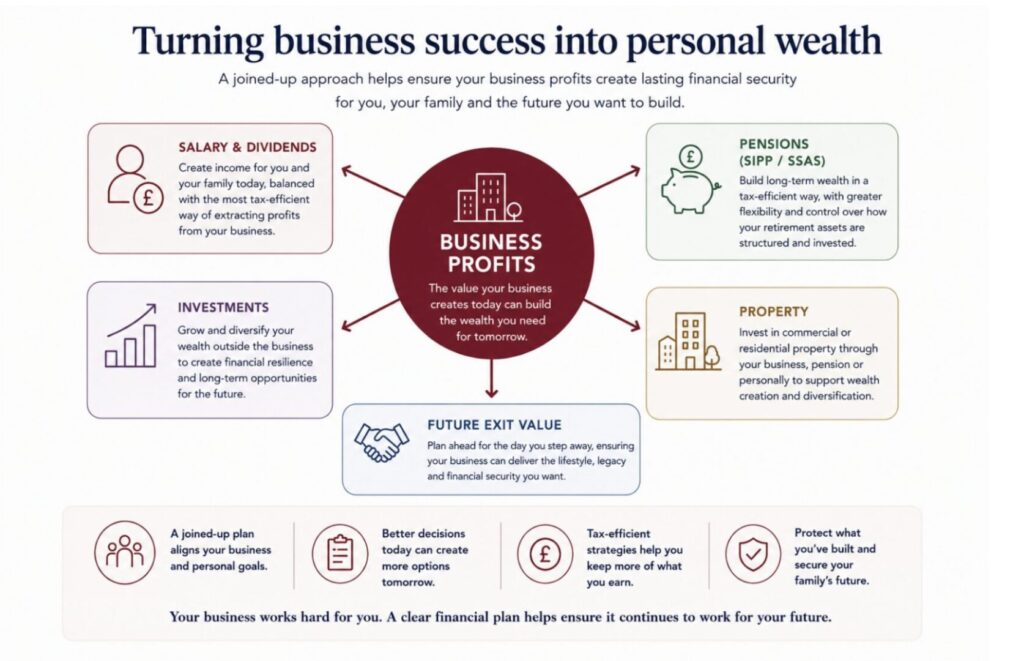
One of the most common challenges business owners face is deciding how best to extract value from their business. The answer is rarely straightforward.
Salary, dividends, pension contributions, retained profits and investment strategies can all play a role depending on personal circumstances, business objectives and prevailing tax legislation.
The most effective approach is often one that balances today’s income needs with longer-term wealth creation objectives. By considering remuneration and wealth planning together, business owners can often create greater flexibility, improve tax efficiency and build personal wealth alongside business growth.
Because what matters is not simply what the business earns, but what ultimately stays with you.
Many business owners find that the majority of their wealth remains tied up within the company. Whilst reinvesting in the business may be appropriate, it is equally important to consider how wealth is being accumulated outside of the business.
Creating personal wealth can provide diversification, flexibility and greater financial resilience. This may involve investments, pensions, property or other long-term planning strategies designed to support future objectives beyond the business itself.
Because one of the most important financial planning questions every business owner should ask is:
“If I stopped working tomorrow, how much of my wealth would remain independent of my business?”

Pensions can play an important role in helping business owners build long-term wealth whilst creating valuable tax planning opportunities.
Employer pension contributions are often one of the most tax-efficient ways of extracting value from a business, whilst helping create assets outside of the company structure.
For many business owners, pensions become an increasingly important part of wider financial planning as retirement approaches and thoughts turn towards succession, future income and long-term financial security.
Because retirement planning should begin long before retirement itself arrives.
Business owners often have access to planning opportunities that are not available to many employees.
Self-Invested Personal Pensions (SIPPs) and Small Self-Administered Schemes (SSASs) can offer additional flexibility and control over retirement planning whilst creating opportunities that may support wider business objectives.
Depending on individual circumstances, these arrangements may be used to hold commercial property, receive employer contributions, support succession planning objectives or form part of a broader wealth accumulation strategy.
In some circumstances, SSASs can also be used to purchase commercial property occupied by the sponsoring business, creating opportunities to align retirement planning and business objectives within the same long-term strategy.
Mattioli Woods has a long heritage in pension planning and SSAS administration, helping business owners understand where these specialist arrangements may form part of a wider financial plan.
Because good pension planning is not simply about retirement. It is about creating flexibility throughout the journey.
Many business owners devote years to building their business but relatively little time to planning what comes next.
Whether the eventual objective is a sale, management buyout, family succession or a gradual reduction in involvement, preparing early can often create better outcomes.
Understanding what the business may be worth, how much capital may ultimately be required to achieve financial independence, and how future wealth could be structured are all important parts of the planning process.
Because the best exits are rarely improvised.
They are planned.
One of the greatest benefits of financial planning is creating clarity.
Business owners often face competing priorities between business growth, family commitments, tax efficiency, wealth accumulation and future retirement plans.
Using cashflow modelling and structured financial planning, we help clients understand how different decisions today may influence future outcomes.
This may involve understanding whether retirement remains achievable, whether wealth accumulation is sufficient, how a future business sale could affect long-term financial security or how personal and business wealth work together.
Because financial planning helps transform uncertainty into informed decision-making.
More than 35 years of experience has taught us that business owners face financial planning challenges that are often very different from those of employees.
In fact, Mattioli Woods was originally built helping business owners navigate the complex financial decisions that come with building and running successful businesses. That heritage remains an important part of who we are today.
Business and personal finances frequently overlap. Decisions made within the business can have significant implications for personal wealth, retirement planning, tax efficiency and family security.
That is why our approach brings together financial planning, tax planning, pensions, investment management, business protection and succession planning within one joined-up framework.
Today, more than 200 salaried advisers support over 30,000 clients across the UK and advise on more than £25 billion of assets.
Our advisers are supported by specialists across pensions, investments, tax planning, employee benefits and corporate services, helping ensure business owners have access to the expertise required as their circumstances evolve.
Many business owners spend years building value within their business. Financial planning helps ensure that value ultimately becomes personal wealth, financial independence and future choice.
There is rarely a single answer to this question.
The most appropriate approach will depend on factors such as your income requirements, business profitability, future plans and prevailing tax legislation. Salary, dividends, pension contributions and retained profits may all play a role within an effective remuneration strategy.
The key is ensuring that decisions support both your current lifestyle and your longer-term financial objectives. What works well for one business owner may not be appropriate for another, which is why remuneration planning is often most effective when considered alongside wider financial planning.
Both approaches can offer advantages depending on your circumstances.
The most suitable structure may be influenced by factors such as tax treatment, access to capital, succession objectives, future business plans and personal financial goals.
For some business owners, retaining surplus profits within the company may be appropriate. For others, extracting funds and investing personally may provide greater flexibility or support wider wealth planning objectives.
The right solution is often determined by what you are ultimately trying to achieve rather than by tax considerations alone.
A Small Self-Administered Scheme (SSAS) is a type of occupational pension scheme often used by business owners, directors and family businesses.
Unlike many traditional pension arrangements, a SSAS can offer additional flexibility and control, allowing members to play a greater role in how the scheme is managed and invested.
Depending on individual circumstances, SSASs may support a range of planning opportunities, including pension funding strategies, commercial property ownership and wider succession planning objectives.
Mattioli Woods has a long heritage in SSAS administration and helping business owners understand where these arrangements may fit within a broader financial plan.
Pensions can be one of the most effective ways for business owners to build wealth outside of their company whilst creating valuable tax planning opportunities.
Employer pension contributions are often treated differently from salary or dividends and can provide a highly tax-efficient route for extracting value from a business.
Beyond the immediate tax benefits, pensions can help create long-term financial independence by building assets that sit separately from the future value of the business itself.
For many business owners, pension planning forms an important bridge between business success and future retirement security.
Ideally, exit planning should begin several years before any anticipated sale, succession event or reduction in involvement.
Early planning can help maximise business value, improve tax efficiency and create greater flexibility around how an eventual transition is structured.
Perhaps more importantly, it provides time to answer some of the wider questions that often accompany an exit: How much wealth is enough? What will retirement look like? How should proceeds be invested? And what role, if any, will the business continue to play in your future?
The most successful exits are rarely last-minute decisions. They are the result of careful planning undertaken well before the exit itself takes place.
A successful business can create significant opportunities.
The challenge is ensuring that the value created within the business ultimately becomes financial security, freedom and choice beyond it.
Whether that means building wealth outside the business, planning for retirement, supporting future generations or preparing for an eventual exit, the most important financial decisions often extend well beyond day-to-day business operations.
For more than 35 years, Mattioli Woods has helped business owners connect business success with personal financial goals through joined-up planning built around clarity, expertise and long-term thinking.
Because building a successful business is only part of the journey.
Turning that success into lasting financial security is what comes next.