
Benefits
Governance and Benchmarking
Helping employers create clearer oversight, stronger decision-making and greater value from employee benefits.

Employee Benefits strategies are becoming increasingly important to workforce engagement, wellbeing and overall organisational performance.
As benefits strategies become broader and more complex, employers increasingly want clearer oversight around provider performance, employee engagement, governance responsibilities and the overall value being delivered across the workforce.
At Mattioli Woods, our governance and benchmarking approach combines consultancy, insight and strategic oversight to help employers create more informed, measurable and commercially effective employee benefits strategies.
Because the strongest employee benefits strategies are not simply implemented. They are reviewed, measured and continuously improved over time.
Governance should support more than compliance alone
Employee Benefits governance should support more than annual renewals and regulatory responsibilities.
Modern employers increasingly want greater visibility around workforce engagement, provider effectiveness, communication performance and the overall impact benefits are having across the organisation.
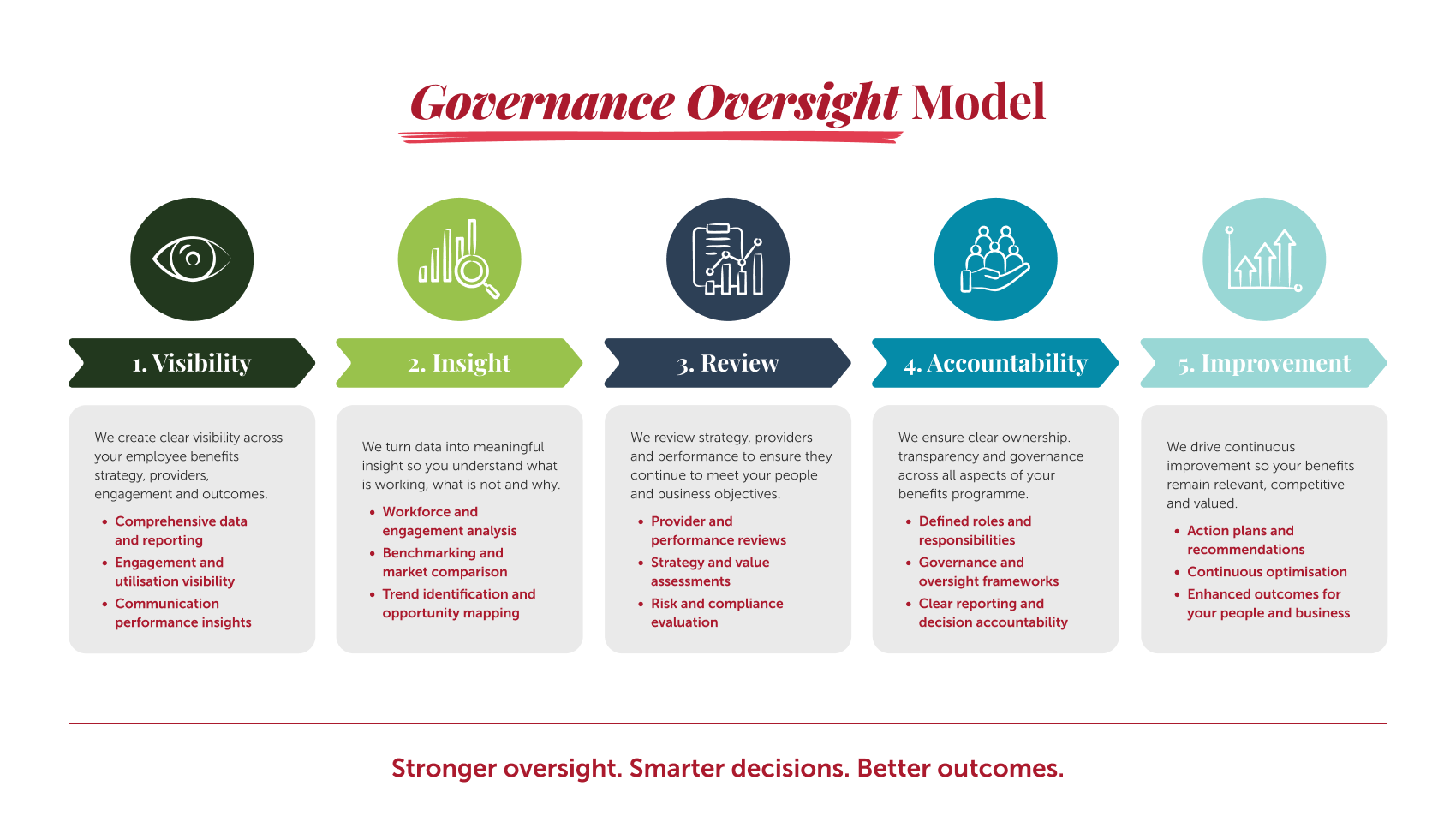
Our approach helps employers think more strategically about governance, oversight, benchmarking and continuous improvement – helping employee benefits become a more measurable and more accountable part of the wider workforce strategy.
Because governance is increasingly about understanding whether benefits are genuinely supporting employees and organisational objectives.
Creating clearer oversight across employee benefits
Many organisations operate multiple benefits providers, advisers, platforms and employee support arrangements across pensions, wellbeing, healthcare, protection and reward.
Without strong governance and oversight, employee benefits can quickly become fragmented and difficult to evaluate effectively.
Our governance approach helps employers create greater clarity through strategic reviews, provider oversight, workforce insight, engagement analysis and ongoing governance support designed to improve visibility across the wider employee benefits strategy.
The objective is not simply to review benefits periodically.
It is to help employers make more informed long-term decisions around workforce support, engagement and overall value.
Benchmarking against workforce and market expectations
continue to evolve, and many employers increasingly want to understand how their benefits strategy compares against wider market practice, workforce expectations and competitor positioning.
Employee expectations around workplace benefits
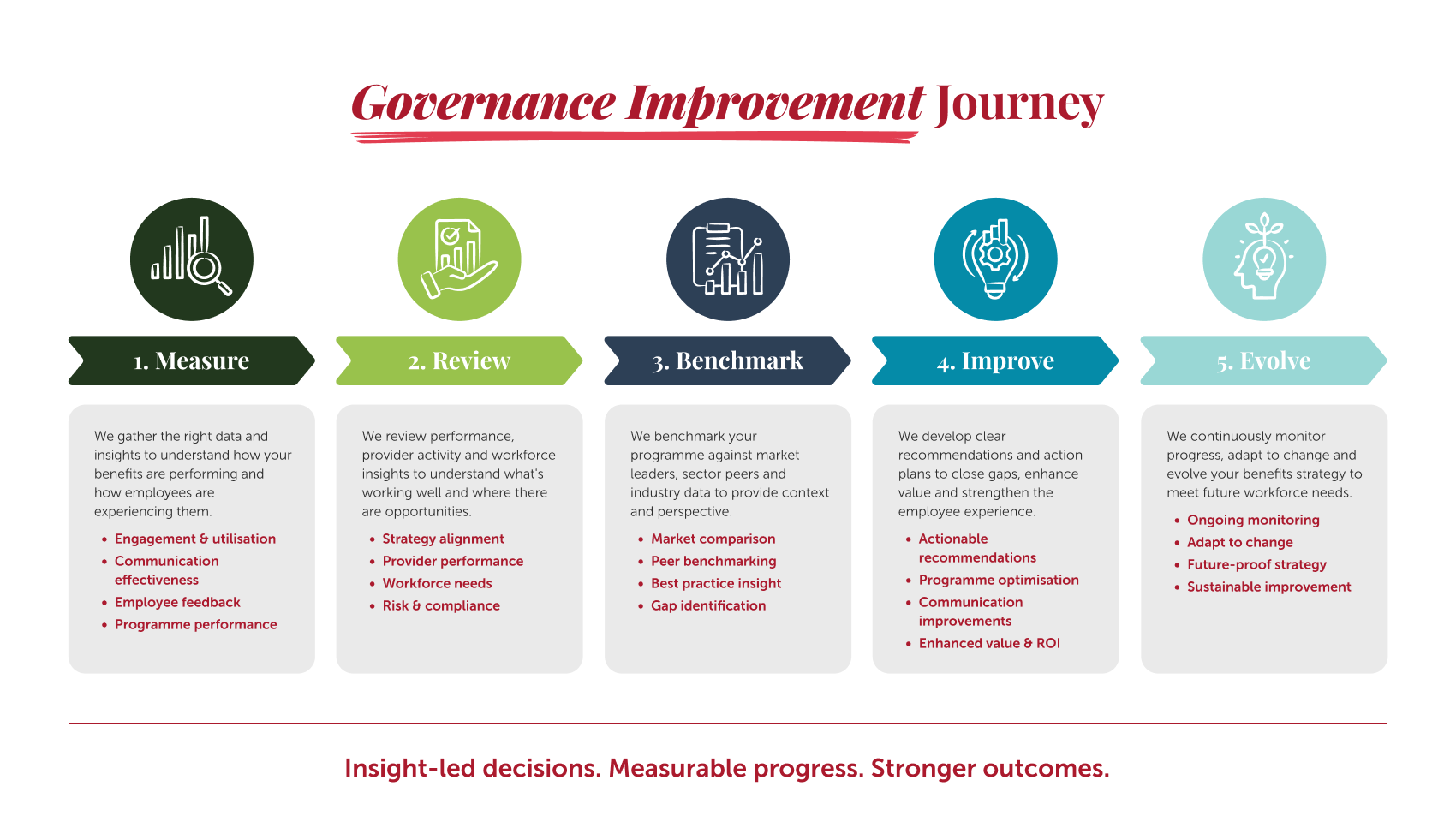
Our benchmarking support helps employers assess areas including workforce engagement, benefit utilisation, communication effectiveness, provider value, market competitiveness, wellbeing support and the wider employee experience – helping organisations identify opportunities to strengthen engagement and improve overall benefits value across the workforce.
Because the strongest employee benefits strategies are increasingly shaped by insight, comparison and continuous refinement over time.

Governance that supports better workforce decisions
Governance should help employers move beyond assumption and towards more informed workforce decision-making.
Our consultancy-led approach helps employers create clearer governance structures and stronger oversight around engagement, communication, utilisation and workforce trends — helping support more strategic conversations internally around employee benefits and wider workforce priorities.
Because the most effective employee benefits strategies are increasingly those that can clearly demonstrate relevance, engagement and measurable organisational value.
Understanding engagement and utilisation
Strong governance increasingly depends on understanding how employees are actually engaging with benefits across the organisation.
Low engagement or low utilisation does not always reflect lack of value. In many cases, employees may simply lack awareness, understanding or confidence around the support available to them.
Our governance and insight approach helps employers create greater visibility around employee behaviour, communication effectiveness and workforce engagement trends — helping organisations identify where stronger communication, visibility or support may improve overall employee experience and utilisation.
Because employee benefits only create value when employees genuinely engage with them.
Technology and workforce insight
Technology increasingly plays an important role in helping employers strengthen governance and workforce oversight.
Our platform capability helps provide clearer visibility around communication, engagement, utilisation and employee interaction across the wider benefits experience — helping employers access more meaningful workforce insight and reporting.
Because stronger governance increasingly depends on access to clearer, more measurable workforce data.
Governance as part of the wider employee experience
Governance should not sit separately from the wider employee experience.
Our approach helps employers connect governance more closely with communication, engagement, wellbeing, pensions and workforce strategy – helping organisations create more joined-up and more measurable employee benefits experiences.
Increasingly, employers want benefits strategies that are not simply well-managed operationally, but capable of demonstrating clear workforce value and long-term organisational impact.
Because governance increasingly supports both workforce outcomes and strategic business decision-making.

Supporting long-term workforce strategy
Employee Benefits increasingly form part of wider workforce strategy around attraction, retention, wellbeing and employee engagement.
Our governance and benchmarking approach helps employers create more informed long-term strategies aligned to workforce priorities, organisational objectives and changing employee expectations.
This can include support around provider reviews, governance structures, workforce benchmarking, communication effectiveness, engagement analysis and wider employee benefits strategy development.
Because the strongest workforce strategies are increasingly built on insight, accountability and continuous improvement.

FAQs
Frequently Asked Questions
Why is governance important in employee benefits?
Governance helps employers create clearer oversight around provider performance, employee engagement, communication effectiveness and the overall value being delivered through employee benefits.
Strong governance can also support better workforce decision-making and continuous improvement over time.
What is employee benefits benchmarking?
Benchmarking helps employers compare their employee benefits strategy against wider market practice, workforce expectations and competitor positioning.
This can help organisations identify opportunities to improve engagement, competitiveness and overall employee experience.
What governance support does Mattioli Woods provide?
We support employers through governance reviews, provider oversight, workforce benchmarking, engagement analysis, communication assessment and wider employee benefits consultancy.
Our approach combines consultancy, insight and integrated workforce support.
How often should employee benefits strategies be reviewed?
Employee benefits strategies should typically be reviewed annually alongside ongoing monitoring of workforce engagement, communication effectiveness, utilisation trends and wider workforce priorities.
Because employee expectations and organisational needs continue to evolve over time.
What role does engagement play in governance?
Employee engagement provides valuable insight into whether benefits are genuinely being understood, accessed and valued across the workforce.
Strong engagement data can help employers make more informed decisions around communication, benefits design and wider workforce strategy.
Helping employers create more measurable and effective employee benefits strategies
Governance should support more than oversight alone.
It should help employers create more informed, more measurable and more effective employee benefits strategies across the organisation.
At Mattioli Woods, our governance and benchmarking approach combines consultancy, workforce insight and strategic oversight to help employers create employee benefits strategies that feel more connected, accountable and aligned to wider workforce priorities.
Because the strongest employee benefits strategies are not simply maintained. They are continuously reviewed, improved and strengthened over time.