

Tax planning is not about avoiding tax. It’s about making informed, legitimate decisions so your money is structured efficiently and aligned to your wider financial plan.
At Mattioli Woods, we help individuals, families and business owners understand how tax affects their wealth, income, investments, pensions and estate planning. Our role is to bring clarity to complex rules and help you make decisions with the full picture in mind.
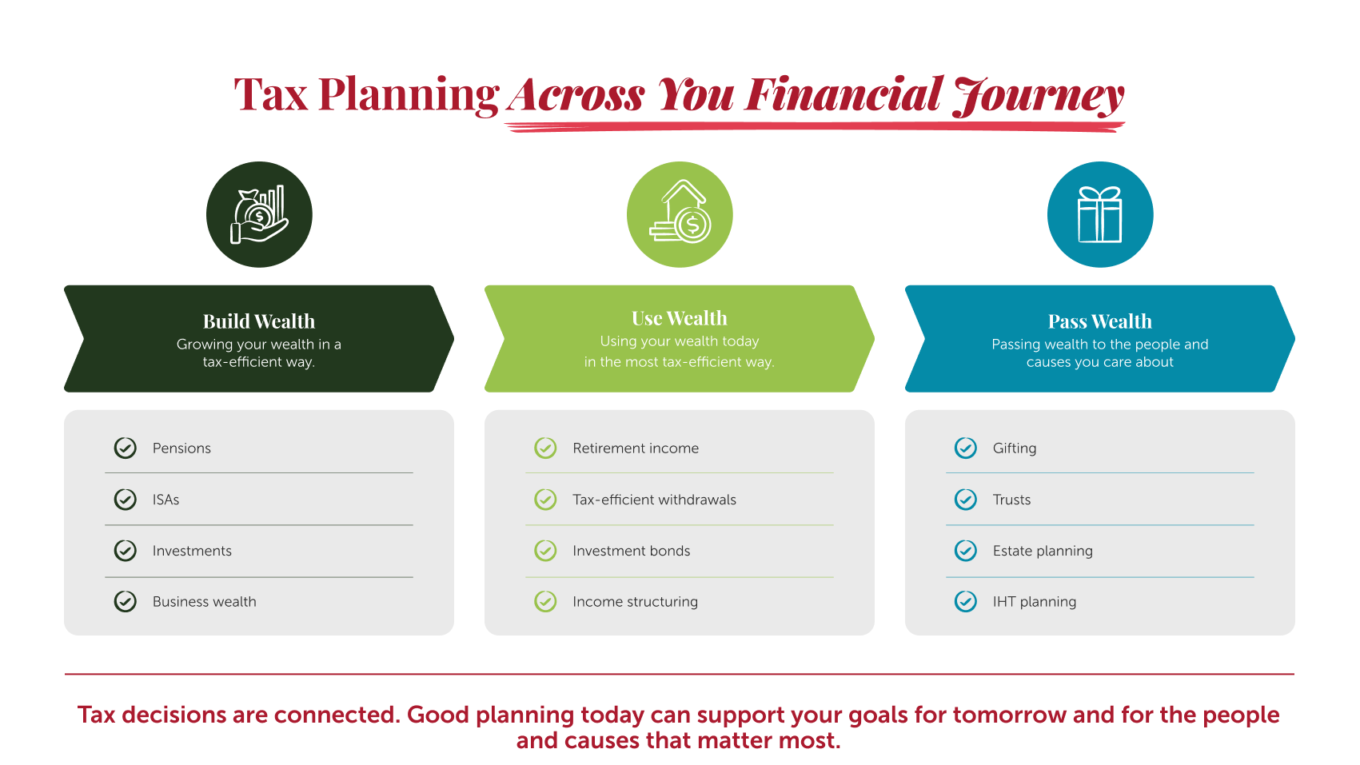
Tax rarely sits in isolation; it connects to how you invest, take income, plan for retirement, support your family, and pass wealth on.
Tax rules can change, and the impact of taxation depends on personal circumstances, so advice should always be tailored to the individual.

Tax planning built around your life
Good tax planning starts with understanding what you want your wealth to do.
That may mean building long-term financial security, creating sustainable retirement income, helping children or grandchildren, selling a business, reducing Inheritance Tax exposure, or making better use of available allowances.
We take time to understand your goals first. Then we consider how tax planning can support those goals in a way that feels clear, structured and appropriate.
This may include pensions, Individual Savings Accounts (ISAs), investment bonds, trusts, gifting strategies, Inheritance Tax planning, Business Relief investments, Venture Capital Trusts, Enterprise Investment Scheme investments, or other tax-efficient solutions where suitable.
The aim is not complexity for its own sake. The aim is clarity, efficiency and confidence.

Bringing structure to complex tax decisions
Tax decisions can quickly become fragmented.
Retirement income, investments, pensions, inheritance planning and taxation are all connected. Decisions made in one area can often affect another, sometimes in ways that are not immediately obvious.
That is why our approach is built around joined-up planning.
Using structured financial planning, cash-flow modelling and our MW⁶ framework, we help clients understand where they are today, what their future could look like, and how tax planning decisions may shape outcomes across the short, medium and long term.
This helps bring greater clarity to questions such as:
- How should I draw income in retirement?
- Which assets should I use first?
- How can I invest more tax efficiently?
- Should I gift money during my lifetime?
- How can I reduce Inheritance Tax without compromising my own security?
- How do pensions, ISAs, bonds and trusts work together?
Helpful Tools
Tools that bring your plan to life
Better understand your financial position with our helpful tools.
Areas where tax planning can help
Retirement income planning
How you draw income in retirement can make a significant difference to how long your wealth lasts and how much tax you pay.
We help clients consider how pensions, ISAs, cash, investment accounts and bonds can work together to create sustainable, tax-efficient retirement income.
Investment tax planning
Investments can be structured in different ways depending on your goals, time horizon and tax position.
We can help you consider the role of ISAs, pensions, General Investment Accounts, investment bonds and specialist tax-efficient investments as part of a wider plan.
Inheritance Tax and estate planning
Passing wealth on thoughtfully often requires early planning.
This may include wills, Lasting Powers of Attorneys, gifting strategies, trusts, whole of life insurance, Business Relief investments and wider family wealth planning.
The aim is to help you support the people and causes that matter most, while maintaining your own financial security.
Business owner tax planning
Business owners often face more complex planning needs, particularly around profit extraction, pension contributions, business sales, succession planning and personal wealth structuring.
We help business owners think beyond the business itself and build a plan for the wealth it creates.
Specialist tax-efficient investing
For suitable clients, specialist investments such as VCT, EIS and Business Relief-qualifying investments may support broader tax planning objectives.
These investments can involve higher levels of risk, reduced liquidity and greater complexity, so careful suitability assessment is essential.
Advice that stays connected
Tax planning should not be a one-off exercise.
Rules, allowances and family circumstances change. At the same time, investment markets move and retirement plans evolve.
That’s why we review tax planning as part of your wider ongoing financial plan, helping ensure decisions remain appropriate as your life develops over time.
At Mattioli Woods, tax planning is not treated as a standalone technical exercise. It’s part of helping you build, protect, use and pass on wealth with greater clarity and confidence.

FAQs
Frequently asked questions
What is tax planning?
Tax planning involves structuring your finances efficiently so you can make informed decisions around income, investments, retirement and passing wealth on. The aim is not to avoid tax, but to help ensure your financial arrangements are aligned to your wider goals and personal circumstances.
Why is tax planning important?
Tax can affect almost every area of financial life, from investments and retirement income to inheritance planning and business ownership. Good planning can help improve efficiency, reduce unnecessary tax exposure and ensure decisions work together within a wider long-term financial plan.
When should I start thinking about tax planning?
Earlier than most people think.
Tax planning is often most effective when considered over time rather than reactively. Decisions around pensions, investments, gifting, retirement income and estate planning can all benefit from long-term thinking and early preparation.
Is tax planning only for high-net-worth individuals?
No. Tax planning can be valuable for a wide range of people depending on their circumstances.
Whether someone is building wealth, approaching retirement, selling a business, investing for the future or thinking about inheritance planning, understanding how tax affects financial decisions can help create greater clarity and efficiency.
What areas can tax planning cover?
Tax planning may involve pensions, ISAs, retirement income planning, Capital Gains Tax planning, Inheritance Tax planning, trusts, investment bonds, gifting strategies and specialist tax-efficient investments where appropriate.
Advice should always reflect individual circumstances and wider financial goals.
What is Inheritance Tax planning?
Inheritance Tax planning involves structuring wealth thoughtfully to help support future generations while maintaining your own financial security.
This may include wills, trusts, gifting strategies, Business Relief investments, whole of life insurance and wider estate planning considerations.
What is tax-efficient investing?
Tax-efficient investing refers to using investments and allowances in a way designed to improve after-tax outcomes over time.
Depending on circumstances, this may involve ISAs, pensions, investment bonds, Venture Capital Trusts (VCT), Enterprise Investment Scheme investments (EIS) or other specialist investments.
These solutions can carry different levels of risk and may not be suitable for everyone.
How does tax planning fit into wider financial planning?
At Mattioli Woods, tax planning is considered as part of a joined-up financial plan rather than a standalone exercise.
Investment decisions, retirement planning, estate planning and protection are all connected, and good planning helps ensure these decisions work together over time.
Do tax rules change?
Yes. Tax rules, allowances and legislation can change over time, which is why regular reviews and ongoing financial planning are important.
The value of tax treatment depends on individual circumstances and may be subject to future change.