
Businesses
SSAS and SIPP planning for business owners
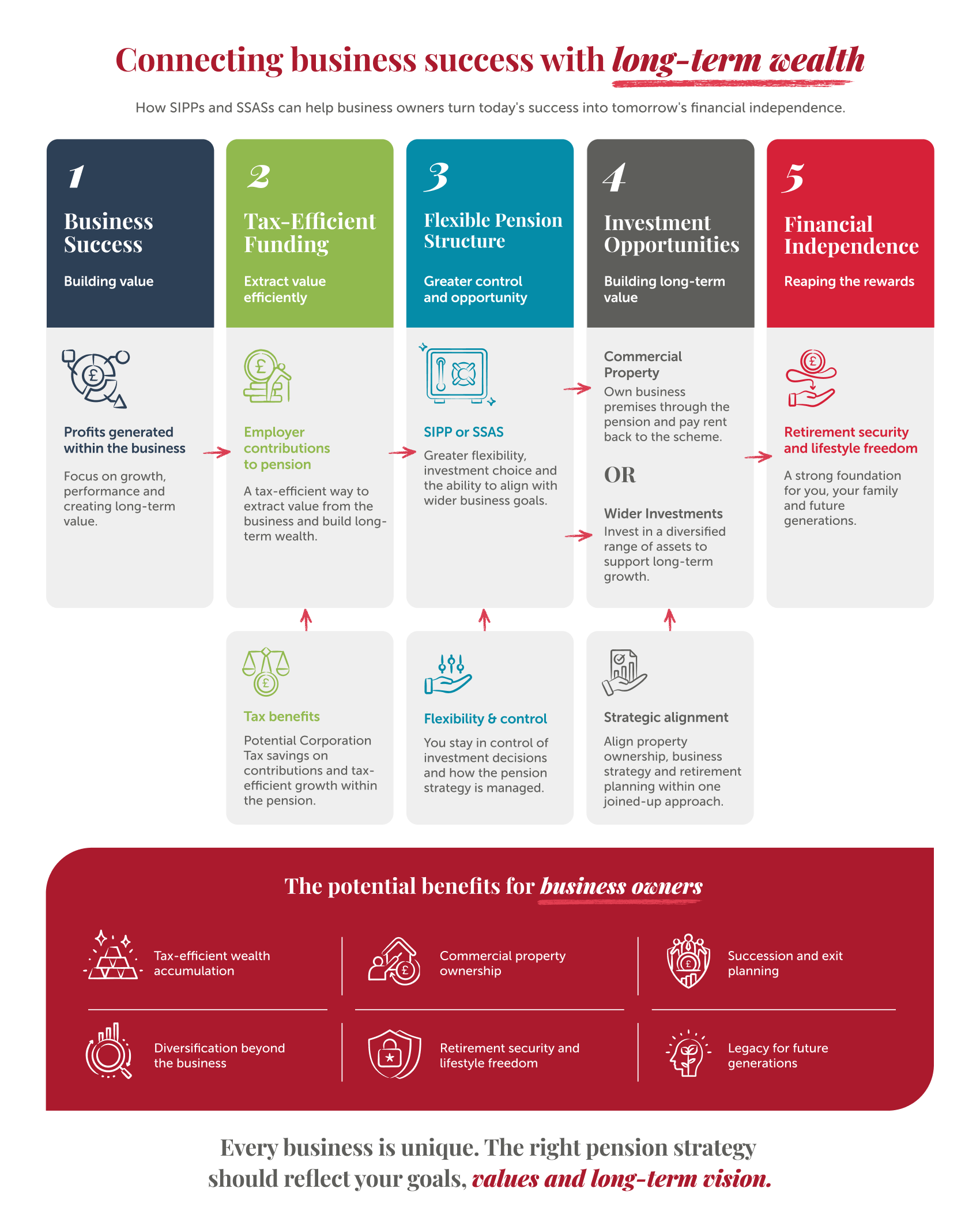
Connecting business success with long-term wealth creation.

For many business owners, pension planning is often viewed as something separate from the business itself.
In reality, the right pension strategy can play an important role in helping business owners build wealth, improve tax efficiency, support succession plans and prepare for retirement.
Arrangements such as self-invested personal pensions (SIPP) and small self-administered schemes (SSAS) can provide opportunities that extend beyond traditional pension planning, helping connect business objectives with personal financial goals.
At Mattioli Woods, we have worked with business owners and pension arrangements for more than 35 years, helping clients understand how pension planning can support wider wealth creation and long-term financial security.
Effective pension planning is about more than retirement. It’s about turning business success into long-term financial independence.
Looking beyond traditional pension planning
Many business owners focus significant time and energy on growing their business while retirement planning remains a future consideration.
However, pension arrangements can often play a valuable role long before retirement becomes the primary objective.
Depending on individual circumstances, pension planning may support tax-efficient wealth accumulation, business succession planning, commercial property ownership, long-term retirement objectives, estate planning considerations and the extraction of value from a business.
The most effective strategies often involve viewing pension planning as part of a wider financial plan rather than a standalone arrangement.
What is a SIPP?
A self-invested personal pension (SIPP) is a pension arrangement that provides greater flexibility and control over how retirement assets are invested.
For business owners, a SIPP can provide access to a broad range of investment opportunities while supporting long-term retirement planning and wider wealth creation objectives.
Depending on individual circumstances, a SIPP may also be used to acquire commercial property, creating opportunities to align property ownership with broader financial planning goals.
Greater flexibility can create additional planning opportunities.

What is a SSAS?
A small self-administered scheme (SSAS) is an occupational pension arrangement often used by business owners and directors.
Unlike many traditional pension arrangements, a SSAS can offer additional flexibility and may create opportunities to integrate pension planning more closely with wider business objectives.
For many owner-managed businesses, a SSAS becomes an important part of a broader strategy that connects business growth, pension planning, commercial property ownership and long-term wealth creation.
Sometimes the most effective planning occurs when different elements of your financial life work together.

Commercial property and pension planning
One of the most valuable opportunities available to some business owners is the ability for a SIPP or SSAS to acquire commercial property occupied by their business.
Rather than paying rent to a third-party landlord, the business pays rent to the pension arrangement.
This can create a number of potential benefits, including helping build retirement wealth, creating a tax-efficient flow of funds and retaining greater control over business premises.
For many business owners, this approach creates a powerful connection between business ownership, property ownership and retirement planning.
The property your business occupies can potentially become part of your retirement strategy.
Tax-efficient funding opportunities
Pension contributions can often provide one of the most tax-efficient ways for business owners to build long-term wealth.
Depending on individual circumstances and prevailing legislation, employer contributions may provide opportunities to extract value from a business while simultaneously supporting retirement objectives.
The suitability of any approach will depend on personal circumstances, business objectives and tax rules at the time.
Effective planning is often about making the most of opportunities available today while preparing for the future.
Supporting succession and exit planning
Many business owners spend years focusing on building value within their business.
Pension planning can play an important role in helping ensure that value ultimately translates into personal financial security.
Whether the objective is retirement, succession or a future sale, arrangements such as SIPP and SSAS can form part of a broader strategy designed to reduce reliance on a future business exit as the sole source of retirement wealth.
Financial independence is often strongest when wealth is built across multiple assets rather than relying on a single outcome.

The Mattioli Woods approach
Pensions have been part of the Mattioli Woods story since the very beginning.
For more than 35 years, we have worked closely with business owners, helping them navigate the opportunities and complexities associated with pension planning.
Our advisers help clients understand how SIPP, SSAS and wider retirement planning arrangements fit within their overall financial strategy, ensuring decisions remain aligned with business objectives, family goals and long-term aspirations.
Where specialist legal or accountancy advice is required, we work closely alongside professional advisers to ensure planning remains joined up and coordinated.
The most effective pension strategies are rarely viewed in isolation; they’re built around the wider life and ambitions of the business owner.

FAQs
Frequently asked questions
What is the difference between a SIPP and a SSAS?
Both SIPP and SSAS offer greater flexibility than many traditional pension arrangements, but they are designed for different circumstances.
A SIPP is an individual pension arrangement that provides control over investment decisions and access to a broad range of investment opportunities. A SSAS is an occupational pension scheme typically established by business owners and directors, often creating additional opportunities to align pension planning with wider business objectives.
The most appropriate arrangement will depend on factors such as business structure, retirement goals, succession plans and the role pension planning is intended to play within a broader financial strategy.
Can a SIPP or SSAS buy commercial property?
In certain circumstances, yes.
Both SIPP and SSAS may be able to acquire commercial property, including premises occupied by a business. This can create opportunities to align business ownership, property ownership and retirement planning within a single long-term strategy.
For many business owners, this approach can help build retirement wealth while providing greater control over business premises. Suitability will depend on individual circumstances and prevailing legislation.
Can my business pay pension contributions?
Employer pension contributions can often provide a highly tax-efficient way for business owners and directors to build retirement wealth.
Depending on individual circumstances and prevailing legislation, contributions may help extract value from a business while simultaneously supporting long-term financial objectives.
The most appropriate contribution strategy will depend on factors such as profitability, remuneration arrangements, existing pension benefits and future retirement goals.
Are SIPP and SSAS only for larger businesses?
No.
While SSAS are often associated with owner-managed businesses and company directors, the most appropriate arrangement depends on planning objectives rather than business size alone.
For some business owners, the flexibility and planning opportunities available through a SIPP may be sufficient. For others, a SSAS may provide additional benefits, particularly where pension planning forms part of a broader business and succession strategy.
When should I start thinking about pension planning?
Ideally, much earlier than most people do.
For many business owners, pension planning can support wealth creation, commercial property ownership, tax efficiency, succession planning and retirement objectives throughout the lifecycle of the business.
The earlier planning begins, the greater the opportunity to build flexibility, create options and reduce reliance on a future business sale as the sole source of retirement wealth.
Effective retirement planning is rarely about preparing for retirement alone. It’s about making better decisions throughout the journey.
Building wealth beyond the business
For many business owners, the business will always be a significant asset.
The challenge is ensuring long-term financial security is not dependent upon the business alone.
At Mattioli Woods, we help business owners use pension planning as part of a broader strategy designed to build wealth, create flexibility and support future financial independence.
Some of the most effective business planning is not just about building a successful business; it’s about ensuring that success creates lasting financial freedom.