





Global markets summary
July told two stories. In the first week, rising tension between the United States and Iran pushed the price of Brent crude briefly above $100 a barrel, lifting energy shares and commodities and reviving concerns over inflation. As those tensions eased, attention returned to the theme that has dominated 2026: whether profits from the artificial intelligence boom can keep pace with the enthusiasm behind them.
Second-quarter results did not mark a retreat from AI, but they did make investors considerably more discerning about where the real profits will land. The largest technology companies held up reasonably well, yet semiconductor firms and other AI beneficiaries came under real pressure, as stretched valuations, tighter export controls and China’s advancing capability all weighed on sentiment. Forced selling by some hedge funds deepened the move; the MSCI World Semiconductors Index fell 13.2% over the month and the broader MSCI World Information Technology Index lost 4.1%. Set against strength in energy and financials, this meant value stocks outperformed growth by more than six percentage points, a sharp reversal after years of growth leadership.
These crosscurrents played out differently by region. UK equities were among the more resilient developed markets, rising 3.87% and now up 11.79% for the year, helped by a lighter weighting in technology and a heavier one in the banks, energy and other areas that performed best in July. The United States faced a sterner test: the S&P 500 fell 1.50% in sterling terms as investors questioned AI valuations more critically, and Kevin Warsh’s appointment as Federal Reserve chair brought a more cautious, hawkish tone on interest rates. The US market nonetheless remains comfortably ahead for the year, up 9.35%. Japan eased slightly, down 0.36%, but remains one of 2026’s outstanding markets, up 16.90%, while emerging markets and Asia ex Japan gave back some of their strong first-half gains as investors trimmed exposure to Korea and Taiwan, the two markets most tied to the global semiconductor supply chain.
Fixed income had a quieter month. Gilts and global corporate bonds slipped as yields edged higher, a repricing rather than a sign of weaker credit quality, while high yield bonds held up better on the strength of their income. Gold suffered one of its sharpest pullbacks of the year as safe-haven demand faded, and the dollar firmed, though it steadied a little by month end.
July was a timely reminder of how quickly markets can pivot between geopolitics and the AI investment cycle, and that a rally resting on a narrow band of winners was never likely to last indefinitely. We continue to believe that broader leadership makes for a healthier market, and that spreading investments across regions, styles and asset classes remains the soundest approach.
United Kingdom
July proved to be an eventful month for UK markets, shaped by a volatile oil price, a change in political leadership, and a mixed but broadly improving set of economic data.
The dominant theme throughout the month was the ongoing impact of the Middle East conflict on energy markets. Oil prices remained elevated, pushing inflation expectations higher and prompting a more cautious tone from the Bank of England. At its July meeting, the Bank of England opted to hold interest rates at 3.75%, though the vote split (six to hold, three to hike) was more hawkish than markets had anticipated. The Bank acknowledged that inflation, currently running at 2.6%, is projected to rise towards 3.2% by the end of the year as higher energy costs filter through. Policymakers remain watchful for the impact on wages and prices, though they noted limited evidence of these materialising so far.
On the political front, Andy Burnham took office as Prime Minister, bringing with him some early cost-of-living measures, including the removal of VAT on electricity and a £2 bus fare cap, alongside hints at future tax rises and possible wealth taxes. Markets reacted with some caution. Gilt yields nudged above 5% on concerns about fiscal discipline, particularly after Burnham suggested there may be “flexibility” within the existing fiscal rules. The appointment of John Healey as Chancellor was, however, broadly welcomed.
Economic data painted a more encouraging picture over the month. The composite Purchasing Managers’ Index (PMI) for July jumped from 49.3 to 52.1, signalling a return to expansion of economic activity, driven largely by a recovery in services. Consumer confidence also improved meaningfully, rising six points to -17, its highest reading since December. Retail sales came in ahead of expectations, and GDP growth for May held up, with three-month growth of 0.7% beating forecasts. Inflation for June came in below consensus at 2.6%, and private sector wage growth slowed to 2.9%, its lowest level since 2020, both supportive of the case for future rate cuts.
Looking ahead, the direction of oil prices and the fiscal path under the new Government are likely to remain the key swing factors for UK rates, equities, and bonds in the months ahead. We continue to see compelling valuations in the small and mid-cap area of the market, which have delivered two consecutive months of outperformance after a prolonged period of large- cap dominance.
North America
US equities were the epicentre of July’s rotation. The S&P 500 ended the month almost unchanged in local currency terms, but a strengthening pound meant sterling-based investors saw a return of about minus 1.5%, a reminder that currency can matter as much as the underlying market for UK portfolios. Year-to-date, the picture remains much healthier, with the index up around 9.4%, in local terms, and still comfortably positive once translated back into sterling.
Beneath that headline figure, the real story was one of rotation rather than retreat. Money did not leave US equities, it simply moved. Some of the strongest winners from the first half of the year, particularly in large-cap technology, saw profit-taking after an exceptional run, while energy and financials attracted fresh interest; energy shares rose almost 12% over the month. This is a healthier dynamic than a broad sell-off, suggesting investors remain confident in the economy and in company earnings, but are becoming more selective about where they put their money to work.
Second-quarter results reinforced that confidence. With most of the index having reported, earnings were on track to grow by around 36% year-on-year, and the great majority of companies beat expectations that were already set high. Growth remained concentrated in technology and communication businesses, and among the largest AI-related companies in particular, but investors are increasingly demanding evidence that heavy investment in AI is generating a genuine return, rather than rewarding the story alone. That is arguably a healthy discipline for a market that has run hard.
Looking ahead, the backdrop remains constructive: earnings are strong, leadership is broadening beyond a handful of mega-cap names, and demand for US equities remains robust. The main risks are that valuations leave less room for disappointment than they did at the start of the year, and that currency could play a larger role in the returns UK investors experience if the pound continues to strengthen. We continue to hold a deliberately broad mix of US exposure within our funds, blending value, growth and smaller company strategies alongside our core positions, which reduces our reliance on a small number of dominant names and leaves portfolios better placed for a market that is starting to reward selectivity.
Europe
Continental Europe had a quietly encouraging month, delivering modest gains in July and outperforming the US once currency was taken into account. Unlike the US, where returns were driven largely by sector rotation and a stronger pound worked against UK investors, Europe benefited from steadily improving economic sentiment, solid earnings and a broadening recovery across cyclical businesses. The region also continued to close a long-standing valuation gap with the US, helped as much by a re-rating of existing businesses as by earnings growth itself.
Banks were among the strongest contributors, benefiting from a healthier interest rate backdrop than in previous cycles and further re-rating as returns on equity improved from a low base; financials remain one of the cheaper sectors globally. Defence and industrial companies also stayed in favour, supported by structural increases in European defence spending that some now see as Europe’s answer to the US AI theme, a long-term growth driver still in its early stages. European technology, meanwhile, continued to benefit indirectly from the AI investment cycle through semiconductor and chip equipment businesses tied into global supply chains.
The month was not without its complications. Rising Middle East tensions pushed oil prices higher at times, helping energy producers but weighing on transport and consumer-facing businesses, while weaker economic data reignited familiar questions over the strength of the eurozone recovery. Strong earnings did enough to offset these concerns, but they are a reminder that Europe’s improving story remains more fragile than that of the US.
Within our multi-asset funds, we hold exposure to Europe, but remain underweight relative to the UK, which continues to be our preferred way of diversifying away from US technology concentration. Europe offers useful exposure to banks, defence and industrials, but its recovery still leans more heavily on external demand and is more exposed to swings in energy prices and eurozone growth data than the UK. The UK offers a similar tilt toward financials and energy, with the added benefit of attractive valuations, strong dividends and a more resilient domestic earnings base, which we believe make it the more attractive diversifier for now.
Rest of the world
Japan told two stories at once in July. The broad TOPIX index rose 0.89% in sterling terms, while the more technology-heavy Nikkei 225 fell by almost 8%, as semiconductor names came under pressure, the same story that affected markets elsewhere. The gap between the two reflects what each index holds: the TOPIX leans more on banks, industrials and domestically focused businesses, which held up well, while the Nikkei carries a heavier weighting in the chip makers that struggled.
Beneath the monthly noise, the longer-term case for Japan continued to build. Corporate governance reform remains the standout theme, with rising dividends, larger buyback programmes and a growing focus on shareholder returns, turning Japan from what many long considered a value trap into a genuinely shareholder-friendly market. Financials remain among its largest and strongest holdings, benefiting from an economy finally leaving decades of deflation behind, while specialist semiconductor equipment and automation businesses continue to benefit from global AI investment, even without US-style technology giants of its own.
Emerging markets and wider Asia had a rougher month, with the MSCI Emerging Markets index down 4.41% and MSCI Asia Pacific ex Japan down 4.56% in sterling terms, though both remain strongly ahead for the year. China was, as ever, the single biggest swing factor, with sentiment shifting between optimism over policy support and lingering concerns over growth and the property market. The sharper losses came from Korea and Taiwan, where steep falls in semiconductor giants Samsung and SK Hynix, on concerns over China’s advancing chip technology, dragged both markets down heavily and more than offset a positive month for Chinese equities.
These regions remain more exposed to the ebb and flow of the AI investment cycle than most developed markets, given how central semiconductor manufacturing is to their economies, and they are also more sensitive to shifts in US interest rate expectations. That said, valuations remain attractive relative to developed markets, and earnings across much of the asset class have held up well, despite the volatility. We continue to see Japan, Asia and emerging markets as valuable sources of diversification within our multi-asset funds, offering exposure to structural themes, from Japanese corporate reform to global semiconductor demand, that sit outside the US technology names that dominate so much of the developed world.
Fixed income
If equities spent July debating earnings and AI, bond markets spent it asking a different question: have investors become too optimistic about how quickly interest rates will fall? Government bond yields rose across developed markets as higher energy prices and resilient economic data prompted a rethink of the outlook for inflation and interest rates. Central banks left policy rates unchanged, but a broadly cautious tone reinforced the sense that rates are likely to stay higher for longer than markets had hoped.
Gilts had a difficult month as a result. The Bank of England kept its base rate unchanged at 3.75%, but the vote was notably split, with three of nine committee members pushing for an immediate rise to 4.0%. Inflation has fallen to 2.6%, but the Bank flagged that Middle East tensions and higher energy prices could push inflation back up later in the year, and that risks remained tilted upwards rather than down. That was a firmer tone than investors had grown used to, and markets responded by pushing back their expectations for further rate cuts, with longer-dated gilts bearing the brunt as investors demanded a higher premium for holding them; the ten-year gilt yield ended the month around 5.0%, noticeably higher than earlier in the year.
The pattern was similar elsewhere. The Federal Reserve also held rates steady, and a more cautious approach under its new chair, Kevin Warsh, added to uncertainty, given less of the forward guidance markets have come to rely on. The European Central Bank faces a trickier balancing act between softening growth and lingering inflation risk but arrived at a similar conclusion: better to keep options open than commit to a rapid path of rate cuts. Across fixed income more broadly, returns reflected this shift in yields rather than any weakening in company fundamentals; high-yield bonds, with their shorter duration and higher income, held up better than investment grade credit, where the sheer scale of new borrowing by US technology companies to fund AI investment added further supply pressure to an already difficult month.
For fixed income investors the message is a familiar one: higher starting yields remain supportive for returns over the long run, even if they bring more volatility from month-to-month. We continue to hold government bonds within our multi-asset funds as the most reliable protection should the AI investment cycle falter and growth slow, while keeping an eye on inflation risk given how much energy prices have re-entered the conversation this year.
Ask us anything
Q: Can earnings growth, AI investment and improving economic conditions continue to support equities now that valuations are no longer cheap?
A: Our answer is yes, but with an important caveat. Over the past year, these three drivers have clearly worked. US equities remain up around 9 to 10% for the year, Europe has enjoyed one of its strongest relative periods in decades, Japan continues to benefit from structural reform, and emerging markets have delivered strong double-digit gains. The more useful question now is whether these same drivers can keep supporting markets from today’s higher starting valuations.
The most reassuring feature of this year’s rally is that it has been built on earnings rather than optimism alone. US companies have been delivering earnings growth comfortably above 20%, European businesses have consistently surprised to the upside despite modest economic growth, and Japanese companies continue to improve profitability as shareholder-friendly reforms take hold. Markets tend to follow earnings over the long run, and as long as earnings keep growing, equities can continue to make progress even without further help from rising valuations.
The AI story itself is shifting from promise to proof. A year ago, investors were largely paying for potential; today they want evidence of real revenue and profit, which is why leadership has narrowed towards companies with tangible earnings tied to AI spending, while more speculative names have become vulnerable to disappointment. This is a healthy development, and July’s broadening of leadership beyond a handful of US technology names, into financials and energy in the US, banks and defence in Europe, and financials and industrials in Japan, only adds to that sense of sturdier foundations.
Our caution lies in valuations, rather than fundamentals. Markets, particularly in the US, no longer have the room for error they enjoyed twelve to eighteen months ago, so future returns will depend more on earnings delivery and less on investors simply paying more for the same profits. Should earnings disappoint, inflation prove stickier than expected, or bond yields move higher, valuations could come under pressure even if the underlying economy holds up. We therefore remain invested in equities, but with an emphasis on diversification across regions and styles, and a greater focus on earnings quality over exciting stories, rather than concentrating portfolios around a narrow set of winners.
If there is a question you would like to pose to our team, please reply to this email or write to [email protected]
Four key takeaways from July 2026:
• Escalating US-Iran tensions briefly pushed Brent crude above $100 a barrel before easing, reviving inflation concerns and lifting energy shares.
• Investors became more selective within the AI theme, rotating out of some crowded growth names while favouring financials, energy and other value-oriented sectors.
• The UK was among the most resilient developed markets in July, helped by its lighter weighting in technology and heavier one in banks and energy.
• Gilt yields pushed higher after a more hawkish Bank of England vote split (six to hold, three to hike).
MARKET DATA
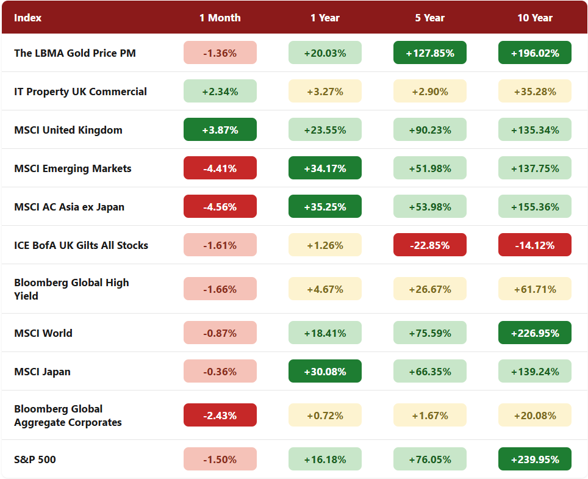
All performance figures are from FE analytics (as at 31/07/2026) and quoted on a total return basis in pounds sterling.
The Monthly Market Commentary (MMC) is written and researched by Scott Bradshaw, Lauren Hyslop and Jonathon Marchant for clients and professional connections of Mattioli Woods and is for information purposes only. It is not intended to be an invitation to buy, or to act upon the comments made, and all investment decisions should be taken with advice, given appropriate knowledge of the investor’s circumstances. The value of investments and the income from them can fall as well as rise and investors may not get back the full amount invested. Past performance is not a guide to the future.
Mattioli Woods Limited is authorised and regulated by the Financial Conduct Authority.
Sources: All other sources quoted if used directly, except fund managers who will be left anonymous; otherwise, this is the work of Mattioli Woods.