
General News
Monthly Market Commentary – July 2026
The Monthly Market Commentary (MMC) is an update on the world in which we invest.

Global markets summary
June will be remembered as the month a peace deal changed everything and nothing at once. The preliminary US-Iran agreement signed mid-month raised hopes of reopening the Strait of Hormuz, but what followed in markets was not a clean risk-on rally: it was a sharp, swift unwinding of the geopolitical trades that had been building for six months. Oil fell hard as supply normalisation was priced in, gold sold off as its safe-haven premium collapsed, and the energy and commodity positions that had carried many portfolios through the year were rapidly liquidated. What looked like risk-off was in reality something more specific and considerably less alarming.
The Strait of Hormuz itself remains far from resolved. The ceasefire is fragile, conditions are highly constrained, and different parties continue to present conflicting accounts of what is actually happening on the water. For energy markets, any comfort around supply should be treated as time-limited.
In sterling terms, European equities were the month’s standout, the EURO STOXX rising 3.21% as the continent’s sensitivity to lower energy costs worked in its favour. The UK added a modest 0.78%, Japan 0.51%, Asia Pacific ex Japan 0.25% and the S&P 500 0.56%. China was the notable laggard, falling 5.64% as investors reassessed its growth outlook against persistent trade uncertainty and lower commodity prices. UK gilts navigated a difficult backdrop, with Middle East uncertainty, domestic political instability and a stubborn inflation outlook all keeping yields elevated and the prospect of a Bank of England rate cut firmly anchored in 2027.
Step back from the monthly noise, however, and 2026 tells a more remarkable story. The second quarter delivered broadly positive returns for investors willing to look through the volatility, and the year-to-date numbers are genuinely striking. Asia Pacific has been the standout, with Korean and Taiwanese markets returning 27.89% in sterling terms as the AI-driven semiconductor cycle powered both economies to record highs. The S&P 500 has returned 11.49% year to date: a remarkable outcome against a backdrop of war, energy shocks and considerable political uncertainty.
Looking ahead, the second half of 2026 appears broadly positive, though the period of easy gains is largely behind us and markets are growing more selective. AI remains the most powerful driver of corporate earnings, and longer-term themes including energy security, rising defence budgets and the approach of the US mid-term elections continue to create opportunity for active investors. Central bank policy and the persistence of inflationary pressures are the risks we are watching most carefully. Our base case is that the global economy returns to full momentum by 2027, and we are positioned constructively for that outcome, while our portfolios retain a deliberate allocation to more defensive assets should events prove less orderly than we expect.
United Kingdom
June proved to be an eventful month for UK markets, shaped by a significant political shift and a cautiously improving economic backdrop. While uncertainty remains, there are grounds for measured optimism as we move into the second half of the year.
The month’s most consequential development was Keir Starmer’s announcement that he will step down as Prime Minister and Labour leader, triggering a leadership contest rather than an immediate change of Government. Andy Burnham is widely seen as the frontrunner in that race, though not yet the ‘near‑certain’ successor, and markets have been sensitive to any signals on fiscal policy continuity. Early indications from senior Labour figures point to maintaining the existing fiscal framework, including commitments on day‑to‑day spending and debt reduction. This has helped reassure investors but the eventual choice of Chancellor and the detailed programme of the new administration will remain key watch points for gilts, sterling and domestically focused UK equities.
On the economic data front, the picture was more encouraging. May’s inflation print was a welcome surprise, with headline CPI holding at 2.8% year on year, below consensus expectations of 3.0% and its lowest level since early 2025, while core inflation has continued to ease from previous highs. Softer food and energy‑related price pressures, alongside a more muted demand environment, are limiting companies’ ability to pass through cost increases. Taken together, these trends are encouraging, though with the Bank of England firmly on hold and rate cuts now looking more likely a 2027 story than a 2026 one, the tailwind for interest-rate-sensitive areas of the UK equity market may still be some way off.
The labour market also showed modest improvement. Unemployment in the three months to April edged down to around 4.9%, slightly better than earlier in the year, while wage growth excluding bonuses held at roughly 3.4%, a touch firmer than expected and still under scrutiny from the Monetary Policy Committee. Meanwhile, first‑quarter GDP growth has been solid, but forward‑looking indicators, including recent PMI surveys and softer construction activity, suggest momentum is beginning to fade as higher borrowing costs and global uncertainty weigh on demand.
Overall, the UK economy is navigating a challenging mix of political transition, still‑restrictive real interest rates and a more fragile global backdrop. Yet softening inflation and a new administration signalling continued fiscal discipline offer reasons for cautious confidence as we enter the second half of 2026. For long‑term investors, this environment argues for remaining invested, with selective opportunities in UK assets that stand to benefit when rates eventually fall, while preserving diversified exposure across regions and sectors to manage ongoing macro and political risks.
North America
June was consolidation rather than advance for US equities, and after the extraordinary gains of April and May, that is no bad thing. The S&P 500 returned 0.56% in sterling terms over the month, a modest headline that belied the continued strength of the underlying story. For the second quarter as a whole, the index rose 14.36%, taking year-to-date returns to 11.49%: numbers that place US equities once again among the principal drivers of global portfolio performance in 2026, powered by solid corporate earnings, the enduring appeal of US technology and an economy that has consistently confounded the pessimists.
The engine of those returns, however, remains notably concentrated. A relatively small group of very large companies clustered in artificial intelligence, cloud computing and digital platforms has accounted for a disproportionate share of the gains. The investment case for these businesses remains compelling, but leadership this narrow raises legitimate questions about sustainability. Investors not paying close attention to their underlying sector and style exposures risk finding their portfolios far more concentrated in a single theme than they realise.
On the macro side, the picture is broadly supportive. Inflation continues to moderate, consumer spending has held firm, and the labour market has stayed resilient. The Federal Reserve, however, is in no hurry to declare victory and the timing of rate cuts remains hotly debated. That combination of cooling but positive growth and the eventual prospect of lower rates is constructive for equities, while also suggesting that the exceptional gains of the second quarter are unlikely to be repeated in the near term. Future returns are more likely to be modest and selective, favouring companies where earnings quality is genuine rather than assumed.
US equities remain one of the most important components of any well-constructed global portfolio, and 2026 has reinforced rather than challenged that conviction. We remain committed to meaningful exposure for long-term investors. The scale of recent gains does, however, demand discipline: valuations in parts of the market are stretched, concentration is high and currency movements add a further consideration for sterling-based investors. Our approach is to stay significantly invested while ensuring that exposure is thoughtfully diversified, pursuing return carefully and managing risk with equal rigour.
Europe
Europe was the standout equity market of June, and the reason is the same one that made it one of the most difficult regions to invest in over the past year: energy. The EURO STOXX rose 3.21% in sterling terms to reach record highs as the preliminary Iran peace deal raised hopes of sustained relief from the energy costs that had weighed so heavily on the continent. Heavily reliant on imported energy, Europe was acutely exposed to the disruption caused by the conflict, and equity markets moved swiftly to price in what normalisation could mean for growth and corporate margins.
The European Central Bank (ECB), however, was not celebrating. The committee raised rates in June, responding to the persistent inflation that the energy shock had driven across the eurozone, and has signalled that price pressures are likely to remain elevated for longer than previously hoped. This captures the central tension of June in Europe neatly: equity markets were looking forward at the potential benefits of lower energy costs while the central bank was still fighting the inflationary consequences of the crisis that preceded them. Growth forecasts are being revised down, political risk across parts of the continent remains live, and the region’s dependence on global trade leaves it exposed to any deterioration in the geopolitical backdrop.
European equities offer a genuinely useful blend of global exporters and domestically focused businesses that complement US and UK exposure in diversified portfolios, but the combination of restrictive monetary policy, weaker growth and unresolved geopolitical uncertainty means this is not a moment to overweight the region aggressively. We remain underweight, focusing on quality companies with broad sector and country diversification, and treating June’s record highs as encouragement rather than a signal to chase.
Rest of the world
The Asia Pacific story in 2026 has never really been a regional story. It has been a North Asian one, and more specifically a semiconductor one. The headline numbers tell part of it: Asia Pacific ex Japan delivered 0.25% in sterling terms in June, a quiet month that followed a quarter in which the region surged 26.89%, taking year-to-date gains to 27.89%. But those returns have been driven almost entirely by two markets sitting at the heart of the global AI hardware revolution.
Taiwan and South Korea have been the engines of the entire regional advance, and the reason is straightforward. Taiwan’s market is overwhelmingly weighted towards advanced semiconductor manufacturing, and the global AI build-out has translated directly into earnings upgrades and index-level performance. Korea has caught a different but equally powerful wave: a memory supercycle driven by hyperscaler demand and AI compute requirements pushing memory prices to record levels, amplified by the high operating leverage of the major producers. Japan has reinforced the theme, its sizeable precision equipment and technology sectors offering meaningful exposure to AI datacentre infrastructure. Together these three markets have generated the regional return. The rest of Asia has largely been a spectator. The foreign selling seen across the region in June was profit-taking in crowded AI winners after an extraordinary run rather than a genuine loss of conviction, and the fundamental semiconductor story in North Asia remains intact.
China told the opposite story, falling 5.64% in June and 7.23% over the quarter. Property sector stress, uneven consumer confidence and stimulus measures that have fallen short of delivering a convincing recovery have all weighed on sentiment, while limited direct exposure to the most profitable parts of the AI hardware value chain has compounded the underperformance. Broader emerging markets have been similarly divided: commodity exporters and technology-driven economies have contributed positively while those facing political uncertainty or slower reform progress have lagged.
The long-term structural case for this part of the world remains compelling, and the semiconductor cycle powering North Asia shows no sign of exhausting itself. We are nonetheless neutral in aggregate on Asia Pacific and emerging markets and deliberate in how we access them. The dispersion within the region is too wide and the concentration of returns too significant for broad index exposure to tell the whole story. Careful country and sector selection has rarely mattered more.
Fixed income
June was broadly constructive for bonds, with many major fixed income sectors delivering modest, income-driven positive returns as mixed inflation data and largely stable credit spreads provided a supportive backdrop. Government bonds on both sides of the Atlantic traded in relatively narrow ranges. UK gilt yields remained elevated by historical standards, after rising meaningfully earlier in the year but by late June, longer-dated gilts had settled into a high but more stable range rather than moving sharply higher again. In the United States, Treasury yields followed a similar pattern, staying high as the Federal Reserve kept rates on hold and maintained a cautious stance, even as inflation showed further signs of easing.
In credit, the picture was constructive across much of the market. Investment grade corporate bonds delivered modest gains, supported by stable spreads and the income benefit of higher-starting yields. Corporate balance sheets remain generally solid, default risks are still contained and sterling corporate bonds continue to offer an attractive balance of income and quality. High yield held up reasonably well, supported by its higher income, though it remains more sensitive to changes in economic conditions and we continue to use it selectively. Emerging market debt was more mixed, reflecting differences in growth, inflation and policy across individual countries, and we favour actively managed strategies over broad index exposure in this area.
Overall, fixed income continues to play a key role in multi-asset portfolios. It is generating meaningful income at today’s yield levels, providing a counterweight to equity risk and offering the prospect of capital appreciation over time if and when central banks eventually begin to reduce interest rates.
Ask us anything
Q: When will the Bank of England next cut rates?
A: It is a question that would have seemed almost rhetorical at the start of 2026. Entering the year, the Bank had already cut rates six times from their peak of 5.25%, and markets were confidently pricing two or three further reductions over the course of the year, with the first expected as early as April. The Iran conflict changed that calculus entirely. The energy price shock that followed pushed UK inflation back above target, gilt yields surged, and the cutting cycle came to an abrupt halt. Since December 2025, Bank Rate has been held at 3.75% through four consecutive meetings, and the debate has shifted from when rates will fall to whether they might yet rise.
The most recent meeting in June illustrated just how much the landscape has changed. The Monetary Policy Committee voted seven to two to hold, but the two dissenting votes were not for a cut: both the Bank’s Chief Economist and an external member voted for an immediate increase. Governor Bailey has described the current stance as an “active hold”, effectively a form of tightening relative to where policy was expected to be, and the committee has flagged that inflation is likely to rise again in the second half of the year as higher energy costs filter through into household bills. Against that backdrop, most major forecasters including Deutsche Bank, J.P.Morgan and Goldman Sachs have now pushed their expectation for the next cut back to spring 2027. A smaller minority believe a single reduction in late 2026 remains possible, but only if the ceasefire proves durable, oil prices ease meaningfully and inflation falls convincingly back towards target. Markets are currently pricing no cuts at all this year, with the marginal risk for later in 2026 tilting towards a hike rather than a reduction.
There is genuine uncertainty here and it is worth being candid about that. The path of UK rates over the next twelve months will depend on factors that remain difficult to predict with confidence: the durability of the peace process in the Middle East, the extent to which higher energy costs feed through into wages and broader prices, and whether growth holds up sufficiently to limit pressure on the committee from either direction. We are monitoring all of these closely. For clients with income needs or portfolios sensitive to interest rate movements, our approach is to maintain fixed income exposure at levels where the income available is attractive relative to the risks involved, while remaining positioned to respond as the picture becomes clearer.
If there is a question you would like to pose to our team, please reply to this email or write to investments@mattioliwoods.com.
Four key takeaways from June 2026:
• The preliminary US-Iran peace agreement dominated June, rapidly unwinding the energy and commodity trades that had built up over six months of conflict.
• Equity markets consolidated their strong second quarter gains rather than extending them, with Europe the bright spot and China the notable laggard.
• UK gilt yields hit multi-year highs as Middle East uncertainty, domestic political instability and sticky inflation pushed the prospect of a Bank of England rate cut firmly into 2027.
• Despite a quieter June, 2026 has been a surprisingly strong year for investors: Korean and Taiwanese markets have returned 27.89% in sterling terms year to date, with the S&P 500 adding 11.49%.
MARKET DATA
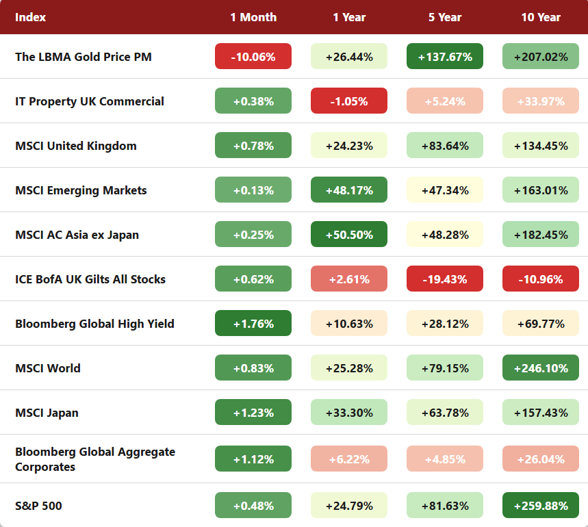
All performance figures are from FE analytics (as at 30/06/2026) and quoted on a total return basis in pounds sterling.
The Monthly Market Commentary (MMC) is written and researched by Scott Bradshaw, Lauren Hyslop and Jonathon Marchant for clients and professional connections of Mattioli Woods and is for information purposes only. It is not intended to be an invitation to buy, or to act upon the comments made, and all investment decisions should be taken with advice, given appropriate knowledge of the investorʼs circumstances. The value of investments and the income from them can fall as well as rise and investors may not get back the full amount invested. Past performance is not a guide to the future.
Mattioli Woods Limited is authorised and regulated by the Financial Conduct Authority.
Sources: All other sources quoted if used directly, except fund managers who will be left anonymous; otherwise, this is the work of Mattioli Woods.
You may also like

Mattioli Woods renews Leicester Tigers partnership

Monthly Market Commentary – August 2026

Care costs dominate retirement concerns with most over-55s unprepared for Inheritance Tax hit
No results match your filters. Try a different tab or category.